Thursday, November 22, 2012

Thanksgiving


I am thankful, first of all, for my family: my wife, daughter, mother, father, brother, sister and all those other people connected to me through marriage and blood who love and support me. I'm nothing without them.

I'm thankful too for the families of Woodland Park. Sometimes it doesn't seem fair that I get paid to be surrounded by so much love. These people bless me simply by allowing me to stand with them at the center of it day after day.

I'm thankful they support me in teaching the way I do, that they enter with me each day into the ongoing experiment of education, shoulder to shoulder, my bosses, my colleagues, my assistants, and my friends. I'm thankful for what we've built together and for what we continue to build together. We're a small school, now serving some 60 kids, but as a cooperative, that number must be multiplied by at least 3, when you consider the parents, the grandparents, the aunts and uncles, and the other special grown-ups who week in and week out make our school run the way it does. Without all of us together it's not Woodland Park; each one absolutely essential. And the best part is that all of us are doing it for the exact same reason: love.

I often say that this is how all schools should be, and when people explain to me why that's impossible, I leave my thoughts unspoken: Still, this is still how all schools should be.

What an incredible blessing it is for me to work in a place like this. It's not only, or even mostly, the children or the playing or whatever notoriety I've gained through this blog that makes me ride my bike to Fremont each morning in the dark and rain. It's the love. I know when I open those doors each morning, no matter how much I've had to strain and scramble to be ready, no matter what dark cloud plagues me, that I'm letting in the sun and the air, love embodied, the children, the mamas, the papas, the omas and the opas, everyone of them arriving with their hearts full. And when they pack themselves up at the end of the day, I'm thankful that they are so full to overflowing that there's plenty left behind to warm me as I stand alone in the silence for a moment to reflect on how I'm the luckiest man alive.

I put a lot of time and effort into this blog. If you'd like to support me please consider a small contribution to the cause. Thank you!
Bookmark and Share -->

Wednesday, November 21, 2012

Heart Yoga


(One of the reasons I write this blog is as a tool for personal and professional reflection. Recently, I've been irritated by some of the children persisting in "laughing" at inappropriate times during storytelling. Yesterday I even put energy into kiboshing it. Re-reading this post, written a year and a half ago, helped me get it back into perspective again.)

Your posture will reflect your mental state. We all know this. If you're depressed, tired, or bored, you'll tend to slump. But the really profound part of this is that your posture will in turn determine your mental state. If you assume the posture of the defeated, the dejected, and the weak, you will soon come to feel defeated, dejected, and weak. It's inevitable. But the good news is that if you assume the posture of energy, determination, and cheerfulness you will soon come to feel energetic, determined, and cheerful. This is also inevitable. ~William James

I met my wife Jennifer when I went to work for her public relations firm back in the early 80's. She and her business partner had gone through fire as 20-something business owners, learning from just about every mistake possible. When I went to work for them they were just emerging from near total collapse, a process that two years later found their scrappy little company on the list of the top 20 largest PR firms in the Pacific Northwest.


They had been operating out of an apartment where they faced down the bankruptcy that defeats 90 percent of business start-ups, and had now established a toe-hold in some free office space with just enough furniture to accommodate their two employes, me being the second. Compared to the competition in their downtown office tower digs, Richardson-Hurshell Public Relations was definitely low rent.

To give you the idea, one weekend I helped Jennifer's partner remove some old closet doors from her mother's house, which I then used to fashion a sort of lean-to storage closet around what had previously just been stacks of boxes. That was a major office improvement at the time.


To the outside world, however, as long as we kept it out of the office, R-H was a glam outfit, known for producing slick publicity and grand opening parties the invitations to which people fought over. That we were able to erect this kind of facade for the world to see, of course, is no surprise. We were a PR firm after all, and creating a public image is a big part of their stock-in-trade.

One of our mantras at the time was, "Fake it 'till you make it," a line usually issued in the throes of crisis and in the spirit of gallows humor as the four of us sat hunched in tension around our makeshift conference table. But when we stepped outside our doors, it was with the shoulders back, heads high posture of winners, faking it, faking it, faking it, until finally it was true.

I came to understand that this idiom wasn't a mere PR joke, but rather a practical statement of profound philosophy and psychology.


I'm reminded of this because of all the storytelling we've been doing in class lately, and specifically the "performance" part of our process. By now, all of our storytellers know that their tales are destined to be read in front of an audience and many, if not most, of them have been clearly out for laughs. And like a good audience, we've accommodated them, taking on our part in the audience participation portion by forcing out the sounds of laughter after every sentence. It's become such a part of the rhythm of the process that we're even laughing after sentences that have no business being laughed at, which has become a problem for the kids intending to tell serious, scary, or adventure stories.

Early last week, when we forced out our ritualistic laugh after the first sentence of Sylvia's story, she said, "Don't laugh." And from this we've developed a new story reading convention that has me asking each child whether or not this is a "laughing story" before we begin. In Syvia's case, she wanted her story to be listened to in the way she intended it, but for many of the kids who've come after her, it's become an experiment in the exercise of power to be able to command "no laughing" and have that honored. At least most of the time. There have been a few instances when there has been something genuinely funny in a "no laughing" story and we've all laughed any way -- a genuine laugh, that stands apart from the artificial laughs we've been practicing.


I approve of this new convention, while at the same time, I hope our fake laughter never goes away entirely, and I don't think it will. There's something wonderful in us all laughing together on cue like that, filling the room with sounds of joy, even if it's just a joyful "posture." I've so often watched us start these sessions as a surly, squirrelly, out-of-synch bunch, but through this process of faking our laughter we are drawn together, our collective attention focused on our friend, their story, and our part in that story, which is to punctuate each sentence with laughter, even if we are faking it. I've always loved this, but have never been able to say exactly why, especially when other adults have pointed out how superficial it sounds to them. I've usually shrugged and agreed and taken a "but what are ya gonna do?" attitude.

But it isn't superficial . . . Or rather, it is, but it's more than that too. It's artificial, but it fills me nevertheless with joy. It wasn't until yesterday, when a friend sent me a link to this video of this very wise man that I suddenly realized what we've been doing and why I want to keep doing it:


When we tell our "laughing stories," we're doing yoga for the heart. The joy I feel, and the joy I see in all those faces laughing up at me is real. It tells me we're not faking it any more. It tells me we've made it.


I put a lot of time and effort into this blog. If you'd like to support me please consider a small contribution to the cause. Thank you!
Bookmark and Share -->

Tuesday, November 20, 2012

The Green Step Thingy


I can't remember what this thing is really called. We call it "the green step thingy." We purchased it several years ago when we were in our old facility with its meager outdoor space. The idea was for this to be an indoor toy, something to ride around in the room we called the "gym." It was the only unimpeded flat space we had, and you need something like that with this toy because there is no way to steer it: it goes in a straight line in one direction, and a straight line back. If you want to get it off that track it requires manhandling.


I started wanting it for the same reason I originally wanted the unicycle merry-go-round: it looked like a toy that invited cooperation. Yes, you can ride it alone, but it's infinitely more fun if you can get a buddy or two to join you. It makes adults laugh to see children riding on this thing. There's something endearing about the high-stepping motion it requires, especially when two or more are doing it in sync. It's even more hilarious when adults ride it. It's impossible to ride it without a smile. I especially love it when two kids decide to do it together, face-to-face, one going forward and the other backwards -- they just beam into one another's faces, present together in the somewhat bizarre cooperative effort of making this thing go.


Sadly, we've not used it much at all since moving into our new space 15 months ago, mainly because although we now have a spectacular outdoor classroom, we still lack a flat open space, and who wants to be indoors when we can be out there?


The nub of the matter is that we've been curating the thing, storing it in an aisle of our storage room, meaning that it's life has been reduced to being stepped over and pushed out of the way; a literal impediment. Last week I got fed up with it and, finally, brought it outside, despite our wood chip bestrewn play surface and the aforementioned lack of a flat space. Screw it, I figured, the kids will either figure out something to do with it or we'll get rid of it.


We might not have a flat space outdoors, but there is a long, not-terribly-steep hill that leads from the gate down to our entryway. I figured I'd introduce the green step thingy to our 5's class. When I wheeled it out, they immediately queued up for a turn: one of the things I've come to appreciate about teaching a class full of 5-year-olds: they've quickly internalized the whole class ethic of taking turns. I never wanted a classroom in which kids spent time in lines, but here they are, doing it on their own. During our first week of school I made the comment, "We're going to have to figure out a way to take turns." Rex said, "Everybody line up behind me," and that's been the way it's worked ever since.


I "shadowed" the first couple riders as they set out from the top of the hill, walking backwards just a few steps ahead of them, both to make sure the way was clear of children as well as to be ready to serve as brakes should it go out of control. But just as we learned when we tried our wagons out on this hill, the slope is not too extreme and the wood-chip paved ground prevents the wheels from turning too freely. In other words, we found that getting down the hill was a ton of fun, and not too hazardous.


Getting back up, however, was another matter. At first I took the job of providing an assist in getting it back to the top, but it wasn't a sustainable solution. After everyone had ridden down once, I declared that getting it back to the top of the hill was a job for the kids. It was hard work, enough so that many of the kids decided they didn't need another turn after all. 


The green step thingy has now been outside for a week. The kids aren't lining up for turns any longer. Most of the time, it stands at the bottom of the hill, something to step over or push out of the way. But it is getting used. Every now and then one child will ask another, "Do you want to ride down with me?" Then the two of them push it together to the top, mount the parallel platforms and beam as they take those silly steps back down to the bottom, where they leave it for the next team to form and decide to work together. Perhaps this is how the green step thingy will finally fulfill the destiny I'd originally envisioned for it.


I put a lot of time and effort into this blog. If you'd like to support me please consider a small contribution to the cause. Thank you!
Bookmark and Share -->

Monday, November 19, 2012

Just The Thing You've Been Missing


If you can get your hands on an old mailbox, let me tell you, it's just the thing you've been missing.


For one thing, you can put stuff in it, which is something everyone likes to do.

For another, you can take stuff out again. Then it's empty, so you can put the same stuff back in or try out different stuff.


It can be done alone or with a friend or you can take turns

You can open the door, then close it, then, get this, you can open it again and the stuff you put inside is still there, even if you've left the door closed for a long time. 


Or how about putting up the flag, then putting it down again.

It makes a good sound if you pat on it with your hand or a stick or a toy truck or your hand or a stick or a toy truck.


Some of us like to shout words into it when it's empty, then do it again when it's full.

Someone put sand in it and then we dug it back out. We just might try that again.


You can go around it or duck under it, put stuff on it, or pretend it's a treasure chest. The batteries never run down.

So, if you get your hands on an old mail box, let me tell you, you've really got something.


I put a lot of time and effort into this blog. If you'd like to support me please consider a small contribution to the cause. Thank you!
Bookmark and Share -->

Sunday, November 18, 2012

How We All Achieved Nirvana


We either make ourselves happy or we make ourselves miserable. The amount of effort is the same. ~Carlos Castenada

I do not want what I haven't got. ~Sinead O'Connor

We like to think of young children as living in the moment. Indeed, I've written a number of posts here in which I assert that this is why I most love working with them: they are a constant reminder that Now is the only thing that exists. And they are much, much better at it than are adults with our wizened brains that spend too much time dwelling in the dream worlds of the past and future. This is not to denigrate the warm fuzziness of nostalgia nor the hot excitement of anticipation. And only a fool doesn't learn from the past and plan the future, but you can't live there for long and avoid the twin plagues of regret and worry, the seeds of all misery. 

Now is the dwelling place of happiness. I think that's what we see when we watch children play and wish to be like them. We've all sat in awe of a child immersed in an art or sensory or dramatic play project.  If it's concentration we're witnessing then it's of the deepest and broadest variety, one that makes a universe from painting on paper or the process of repeatedly letting flax seed drain from between our fingers. These are moments around which religions and philosophies are spun. It's called bliss or nirvana or heaven or love.


Now is also the dwelling place of the other people, not just the speculative ones that may or may not exist in the past or future. As teachers and parents we spend much of our time, and even more of our energy, helping children learn appropriate ways to settle disputes, treat friends, and participate in a group, be it a family, classroom or larger community. We're at our best in this when we ourselves are able to enter into the universe of these actual, albeit smaller, people, to fully engage in the flax seed draining from between the fingers of Now. It's not always pleasant, it's an emotional place sometimes, and it's often hard to remember that feelings only exist for right now, not as eternal amplifications of our own emotional history.  It's through the ability to become fully present that we are able to see that their feelings are not our feelings, that their conflict is not our conflict, that their friendship is not our friendship: that is the reality of Now. We are not there to fix things, but rather to help them find their own course through their emotions and conflicts and back toward the blissfulness that is the heart of Now.


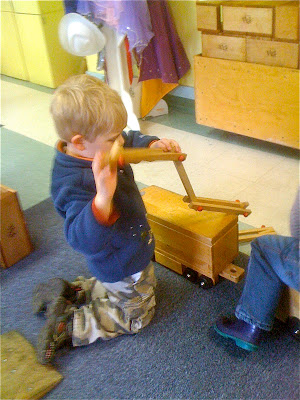
We have a few large, sturdy wooden vehicles: only four train cars and two busses, making them, on some days, a scarce resource, invitations to conflict over "turns." They're fun for pushing and riding: on this day we were riding in circles on a raised track made of large blocks. As others moped over having to wait for their turn I spied one guy playing with one of the two strange apparatuses that we store on the same shelves as the vehicles: they're lengths of wood hinged together in four sections, items of unknown purpose or origin.

I said, "You're playing with that thing."

He answered, "It's my truck."


While the rest of Now was rife with unsatisfied desires, disappointment, and conflict, he had, in the midst of it, satisfied himself from within. I left him then, stepping back to watch from a distance. As he manipulated this thing that looked nothing like a vehicle, I wanted to be where he was, a universe in which trucks were exactly as plentiful as they needed to be. He made gentle motor sounds with his lips as he guided it from one end of our blue rug to the other. Once there, he inadvertently set up shop for a time right in the path of the vehicles going around and around.

"Hey! Get out of our way!"

He didn't hear it, although it had been unnecessarily shouted.

"Move!"

"He won't get out of our way!"

He continued to make those soft motor noises, while carefully watching his truck go through its machinations.  Finally, one boy leaned right down into his face and said, "You better move or I'll be mad at you!"

His bliss was broken then. He looked at the children lined up on their vehicles waiting for him to make way.

I probably should have stayed out of it still, but I said to the boy who had threatened his anger, "I think it works better to ask people politely."

He relaxed his eyebrows, "Will you move, please?"


There was a long moment as this question hung. Finally the boy with the imaginary truck responded by scooting backwards a bit.

As the children filed past, each of them said, "Thank you," as a kind of toll.

Somehow in this process the boy wound up in sole possession of one of the coveted "real" vehicles, although he had never asked for it, and had, in fact, only laid a hand on it to move it out of the way as well. He sat back with it in his lap, not possessing it, but merely being with it. I'm certain that had another child asked for it, he would have handed it over as easily as it came to him.


And that's how we all achieved nirvana, a place where trucks are exactly as plentiful as they need to be.

I put a lot of time and effort into this blog. If you'd like to support me please consider a small contribution to the cause. Thank you!
Bookmark and Share -->

Saturday, November 17, 2012

We Can't Afford The One Trick Pony


There are a lot of nice building sets out there. Whenever I peruse school supply resources or toy manufacturer websites, I'm impressed by the variety of building toys: things that snap together, balance, or magnetically connect. There are big sets for creating things in which children can fit their entire bodies, and small ones that challenge the dexterity of fingertips. 


Of course, being a little cooperative preschool with appropriately tight budgets, we're not usually in a position to purchase these things. Even when we do have the resources, it's still a gamble, especially when we're talking about things that are not tried and true like Tinker Toys, Lincoln Logs, and Legos. Although even those classics have a tendency to become one-trick ponies, capable of holding a child's interest for a day or a week, then needing to be put into storage to make way for something new.


And then, of course, there is the issue of storage, something by which every preschool is challenged.


Mind you, I'm not complaining. Sufficient, yet tight budgets, sufficient, yet tight storage spaces, are good things for a teacher and a school. At least it is for one like ours with a play-based curriculum, one in which the central idea is an environment in which children inquire and explore, where learning emerges from within, rather than being imposed from without. 


As a teacher, I find limited space and resources to be a creative challenge, one that spurs me to find new ways to introduce old things, to seek out strange and unusual freebies, to consider everything that crosses our threshold to be a pony capable of learning an infinite number of tricks. 


For the past week, for instance, our "block area" has been populated by a random collection of what people outside the world of preschool would call "junk": bits of wood, picture frame corners, plastic tubes with lids, cigar boxes, pieces of fabric, carpet samples, florist marbles, egg cartons, car keys, old CDs, and yoghurt containers. I suppose it's a variation on the whole loose parts concept.


All week, the children started their days by walking right past this collection of refuse, sorted categorically into boxes, making a beeline for other, more traditional invitations to play, leaving perhaps one or two friends to explore on their own. But each day, whether the kids were 2, 3, 4, or 5, after quickly exhausting the other stuff they found in the classroom, they all wound up playing there, engaging with materials, engaging with one another, being inspired by one another, and ultimately creating meaning in ways made impossible by "building sets."


What happens with the random stuff is impossible to categorize. It's construction, it's art, it's drama, it's science, it's mathematics, it's literacy, it's music, it's both fine and large motor play. Children created together and alone, making meaning from this meaningless stuff, forming connections between things that have no business being together, things that they will later find on the art table or in the sensory table or outdoors or with the play dough or costumes or recombined with yet more random stuff on a table top in the corner. And then they'll be new again.


Preschool teachers can't afford one trick ponies and that's a good thing.


I put a lot of time and effort into this blog. If you'd like to support me please consider a small contribution to the cause. Thank you!
Bookmark and Share -->