Tuesday, May 25, 2010

A True Labor Of Love


The aspect of our new outdoor classroom with the steepest learning curve has been our construction/tinkering area. While a lot of us have involved preschoolers in woodworking, plumbing, and even electrical work (I learned last night that Connor helped his dad rewire the house) and other projects involving tools, none of us has much experience doing these things with 20+ kids.

We've built some pretty cool stuff over the past 3 months, no doubt, including things like turquoise houses, a sound garden, robots, and a water wall, but we're still working, for instance, on coming to a consensus about how to best insure safety. As we've used our hammers, saws, and drills on a daily basis, we've evolved a good set of guidelines, but from day-to-day, we have enforced those "rules" with more or less vigor depending upon our individual assessments of the danger. That's natural and right in line with the way things always work in a cooperative school, but with each passing day I'm seeing more consistency in how we're walking the balance, as a community, between being safe and offering a fun, meaningful experience for the kids.

Of course, the children have had their own learning curve, and most of them are now starting to understand and take responsibility for their own safety. For instance, many of them are now remembering, unprompted, to don eye protection, and others have started to insist upon a proper amount of workspace. Yesterday, I overheard heard Anjali insisting, "I need more room," before driving a nail, evidence of her growing understanding of how to properly use tools. Safety emerges from proper technique and creating a bubble of space around your project is fundamental to proper tool usage.

In spite of this progress, we've had one glaring problem: storage. We've known from the start that we needed a better storage solution, but for the past 3 months, we've been living with this:


In lieu of proper storage, we've just been heaping our saws, drills, hammers, measuring tapes, sanding blocks, screwdrivers, wrenches, mallets, levels, safety glasses and other sundry items in this Rubbermaid tub. It made a lot of us feel like things were a little out of control, we weren't comfortable with the kids grabbing their own tools, and often we had trouble locating just what we needed.

When I arrived at school yesterday, however, everything had changed. I found this mounted to the wall:


I knew Thomas' father Rob was going to work on a storage solution for us, but not in my wildest dreams did I expect anything like this. Not only will we now be able to find just what we're looking for, but we'll know, at a glance, what we have available and if we need to search for something that's missing. 

If this is all Rob had done for us last weekend, it would have been above and beyond, but he also took on the challenge of our old, pink workbench. It's a solid piece of furniture, and the perfect height for the kids, but after years in the elements, the work surface was rotting, and we'd discovered that the manner of its construction severely limited our ability to use our clamps and vises. Not only did Rob give us a new top, but he made it our own by free-handing our unofficial school logo under the polyurethane.


I feel so lucky this morning. This is a true labor of love, one that will live on beyond Thomas and even his sister Charlotte who begins her own 3 years journey through Woodland Park next September.

Thank you, Rob. I know I'll think about you and your family each and every time I'm out there.


Bookmark and Share

Monday, May 24, 2010

"I Can Do Anything Good"

From the time our daughter Josephine was a baby, I've made a habit of stopping in front of mirrors to say, "I am sooo handsome." Like The Fonz checking his hair only to conclude that, "Heeey," I can put the comb away, it began as a small attempt by a new parent to role model a healthy self-image. It has now, of course, evolved into a family joke, but you get the idea.

I've always loved reading Nancy Carlson's I Like Me! to preschoolers because when that self-loving pig sees herself in the mirror, she says, "Hi, good looking!" 

I Like Me! (Puffin Storytime) Book & CD.

A few days ago Arya's mom and former Woodland Park 3-5's chair Sarah, posted this on my Facebook wall. This little girl is Teacher Tom, The Fonz, and Nancy Carlson's little pig all rolled into one. You will enjoy it.


May you feel like Jessica all day.

Bookmark and Share

Sunday, May 23, 2010

"Then He Weared The Whale As His Hat"

I worked as a writer for many more years than I have as a teacher. One of the most important lessons I've learned about writing is that if your objective is to communicate and compel, you can never write alone. Your reader must be sitting there across from you at all times. The moment you forget about that reader, is the moment you sink into flatness, flabbiness, and self-indulgence.

When I'm carrying a clipboard around class room, it's a signal to the children that I'm collecting stories to be read at circle time. (For details about how we go about doing this, click here.) When we started this storytelling project it was with the idea of providing the kids an outlet more in the nature of journaling than writing: a way for these pre-readers to have their thoughts, ideas and feelings spun out onto a page. The fact that I would later read these stories at circle time was almost an afterthought.

And that may have held true for the first few storytelling sessions undertaken nearly a decade ago, but as it's evolved, it is now exceedingly rare for a child to tell a story without at least a tip of the hat to her intended audience. Since every story we tell at Woodland Park is destined to be read in front of the class, our writers put a great deal of energy into telling stories that will elicit a response, laughter being the most highly prized.

As you read this latest collection of stories, you'll see the obvious attempts at silliness, but what you should also know is that that the parts that read like violence are intended as slapstick. And judging by the wild audience response, they know their "readers."
A baby runs on his head. He bumped into a pair of pants. He bumped into a Easter egg. Then he broke a pot. Then he ran to his head because his head fell off his body. Then his head jumped behind the chair and his body ran past the chair with the head behind it. Then he ran to a wheel and bonked his self on the head. Then he rowed himself in the boat and bumped his self on a fish. And then he weared the whale as his hat. --Luna
It's about why the truck got stuck in a monster truck. The Monster Truck even driving on the rails and then he crashed on a oil can. And then he slipped. And then boomed out of flying out of mission. And then he crashed down in the street. Then he went in the city and crashed into people. And the baby went in the Monster Truck and crashed itself. And he crashed into a train with a house. And he crashed in a house and the ghost went off the cliff and found the baby. And the baby run away and then he said, "Bleh!" --Finn P.
The bunny cuts his ear. And he said, "Wah!" And he said, "Hello!" And he said, "Could I go to the store please." And he bump into somebody's head. And he bumped into a manor. And he bumped his bottom on the wall. And that's the end of my story. --Marcus
A dinosaur one. Then a fence and a soccer ball. And I saw a bucket and there was donkeys. Then knock in the tree. Then a bonked in a door. And then a bonked in . . . I saw a dinosaur! --Charlie B.
It's about a dark, dark night. And then there was a frog and he banged into a door. And then he banged into the tree. And then fell down. --Orlando 
Whoa! I fell over. I fell over again. --Dennis
The cat bump! --Ariya

Katherine, our oldest kid, also gets in on the act, but at the same time she appears to be conflicted about the violent side of her slapstick. I think she wants her audience to know that no animals were hurt in the making of her stories because her squirrels just won't stay dead!

The little puppy goes and had some food. And why he did that he ate the paint brush at the same time he had his food. Then he goes outside, chased a squirrel and ate it. And then the squirrel was still alive and ran away. --Katherine
It's about a little puppy. The puppy ate his food. At the same time he ate glasses. Then he goed outside, chased a squirrel and then it got dead. Then it was still alive and it ran away. Then while it was running away he was surrounded by lots and lots of foxes. And then lots and lots of foxes ate the squirrel for their lunch. But then the squirrel was moving in their tummies. Then it ran out of their mouths. --Katherine

Another sure-fire way to get the audience laughing is to make-up words. I've needed to put limits on the use of made-up words, however, because without them we wind up with stories full of nothing but gibberish. The main rule is that you must also define your made-up words.
The goo goo la la la (a deer). It went to the store and got his rose with bug eyes on it. And then the door snapped the wheel with the peddles on it. And the raindeer tripped on the boots and fell on the hair. He tripped over the pants. And then the letters tripped over the boot, then tripped over the shoelaces and the ear. --Ella
A gaa gaa goo goo goo (a man) and a rail come and knocked the man over. And it was a rolling pin man. And a bonked into a letter outside. And then a hole comed into the store. And then the bonked into another rail. And then it bonked into a flowers. And it bumped into pants. Gaa gaa goo said, "Boo!" --Lachlan
Goo goo gaa gaa (I hide). Big one head. Fell. Giant. Water. Goo goo gaa gaa (I hide). Puppy. All done. --Alex 

Yet another way to appeal to your readers is to start with characters or personalities with whom your readers are already familiar:
Once upon a time there was a girl named Dora and she was a really good explorer. And she had a really good friend named Boots and he was a monkey. And then there was 2 brothers playing a ball game. Whoever gets it in the hoop wins. And they got 5 players. And then he got to go through the crocodile lake. And then go through the star-y forest. And that's how we get to the ball game. And then the team was the story of Dora and Boots won. --Jack
Once there was a little boy named Gretel. And he was rowing on the boat. And he went to his grandma's house. And Little Red Riding Hood came to see his grandma. And he went to the store to buy food. --Marcus

Of course, when in doubt, pure silliness works just fine:

The paint brush fell to dog. Then the video said, "Why am I not in the mailbox?" The video said, "Why don't you just push the bottom out of the way of my diagram?" Then the paint brushes walked to the dog. Then the dog walked the dog. Then the dog ate the paint brush. The dog ate the cow. And then the poodle toots. He ate the paint brush. They drank some just . . . Then whatever thing-a-ma-bobber it ate the whatever video camera. Stop watching TV! The monster truck. --Thomas

And when silliness is combined with a surprise ending, you've really got something.

The bunny rabbit flipped over and popped his head. Then the bucket said nothing. And then the bucket spilled up all over the place. Milk. And the Busy did everything so fast and slow. Then Busy knocked on Slug's door. And then he didn't even wake up at all. And then a flowers came. And then a bamboo came. Just like the same tree like that one. Then more flowers came. Boo! --Anjali
The flower popped on no body. Then the tent came and it bonked on its head. and then the sand box came. And then it just bonked on the watch. And then another tent came. And then the merry-go-round. And then boo! --Anjali
Tricycle. Chair. Umbrella. House. Plants. Face. Wheel. Boo! --Ella

And sometimes all you need is the surprise ending:

It's only one thing. Boo! --Sarah
Boo! --Max
If you want to read more of the kid's stories, here they are in order of appearance:


Bookmark and Share

Saturday, May 22, 2010

An Oasis Of Concentration


One of the most common compliments we receive from the parents of children who have moved on to public school kindergarten is something along the lines of, "(My child) was well prepared for a big, noisy class."

Our public schools, like most across the country, tend to have kindergarten class sizes in the 24-30 range, typically all under the auspices of a single teacher, or perhaps a teacher and assistant. As much as I share the desire for a better student-teacher ratio, it's not changing anytime soon, so it's incumbent upon Woodland Park to help kids develop the necessary skills to thrive in that kind of environment.

One of those necessaries is an ability to concentrate in the midst of hubbub. Being able to stick with a puzzle, for instance, while the kid beside you is in the throes of conflict over a toy, or not losing track of your beading pattern when friends break into a favorite song, are essential survival talents. And the honest truth is that for most of us, our adult worlds are increasingly full of distractions seemingly designed to seduce us away from the task at hand. This is, in fact, a life skill, and while some of us are more temperamentally suited to it than others, it's one that can be honed through practice.

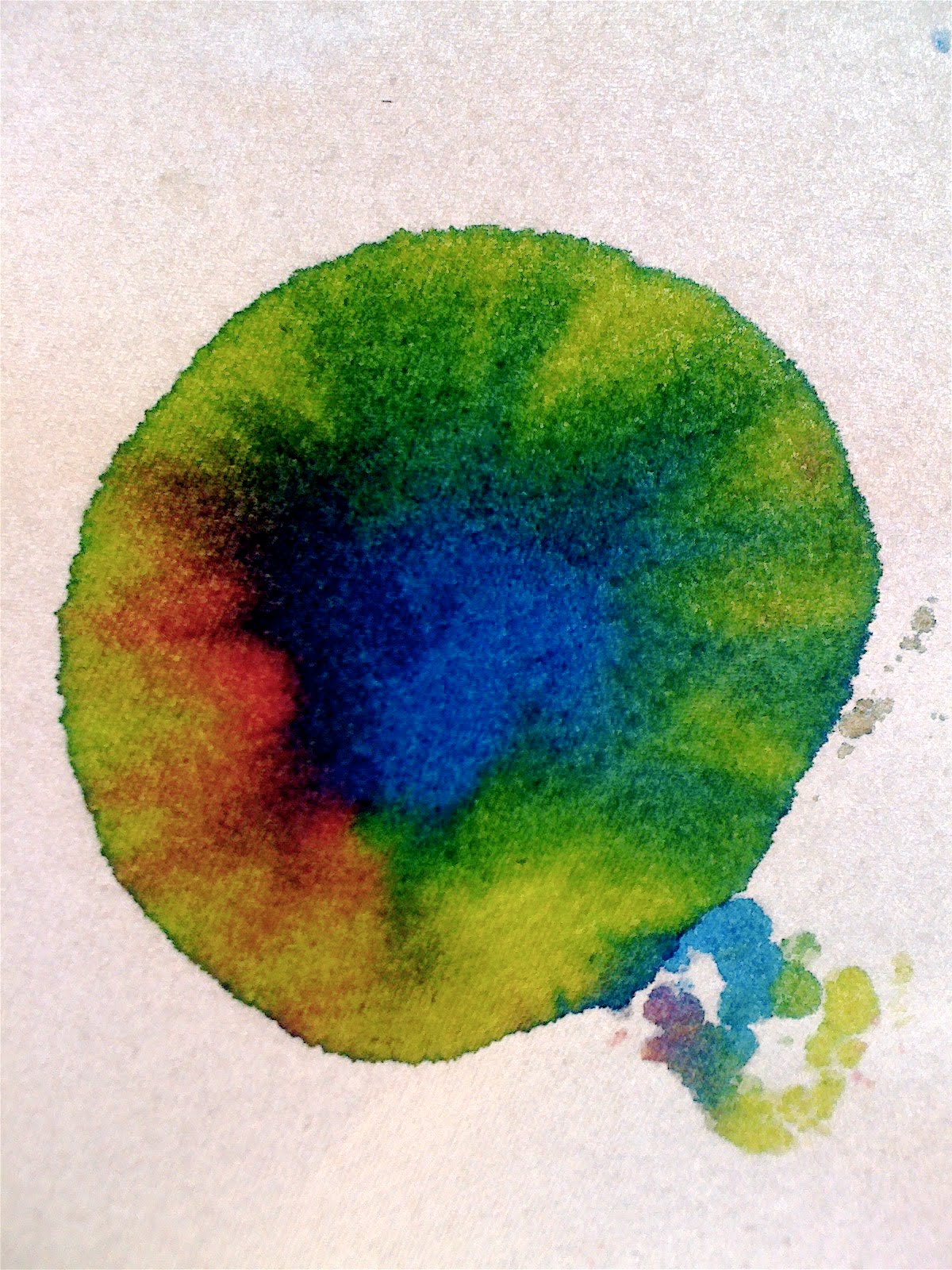
Last week we put our concentration skills to the test with a variation of a project involving suction cup soap pads I learned about over at My Montessori Journey. The idea is to start by using an eye-dropper to carefully deposit a single drop of liquid water color into each of the 3 dozen tiny suction cups. I have a very steady hand and even I found it challenging when I tested the concept before class, so I was prepared for a certain level of frustration, especially from the younger kids.


My concerns were entirely unfounded. Not all tried it, but the ones who did were universally able to block out the usual classroom buzz, including a large motor activity taking place a few feet away and a more active than usual sensory table a few feet away in another direction. I was impressed with their ability to find an oasis of concentration within themselves. I had wondered if kids would get bored with the apparently tedious process of filling all the tiny cups, but most of them, once settled in, didn't stop until they were each charged up with a drop of paint. In fact, some kids got so involved that they then proceeded to place single drops between each of the cups.

The next step of this project is to place a damp paper towel on top of your paint-drop pattern to create a kind of tie-dye effect by virtue of capillary action. 


We used dry paper towels, creating smaller, but more intense color bursts.


These pictures have a sort of unreal look about them because I snapped the pictures while holding them up against the window, but you get the idea. I would have had a lot more photos to show you, but the kids raided the drying racks at the end of class, claiming their own to take home even before they were entirely dry.

This project is a keeper. I'm now thinking about how we can use those soap pads with tweezers and small florist marbles . . .


Bookmark and Share

Friday, May 21, 2010

Riding The Train


We might be down to our final few days of school, but the 3-5 class still managed to wedge in one more field trip yesterday, this one being what I consider to be the mother of all preschool field trips. No matter where we go together, when we return to the school and debrief, it is almost always the bus trip the kids want to talk about. This field trip was special because it had no destination at all. The entire purpose was to ride mass transit.

On Monday and Wednesday, I prepared the kids for what to expect:
"We are going to leave school and walk up to the bus stop together. Then we are going to get on the number 5 bus, ride it downtown and get off. Then we're going to go down some long escalators that will take us underground into a giant tunnel. Then we're going get on the train. Then we will ride on the train, underground. Then we will come out into the light and see Safeco Field. Then we will ride the train through Sodo and up onto a bridge, make a big turn and go right by the Tulley's Coffee building. Then we will go into a dark tunnel in the side of Beacon Hill: the station inside Beacon Hill will look like a space ship. Then we will come out of the tunnel and ride the train to the Mt. Baker station which is built on a bridge. Then we will get off the train and go down a looong escalator, walk under the train tracks, then go up a looong escalator on the other side. Then we will get back on the train, go back into the tunnel, go back past the space ship station, go back over the bridge, go back through Sodo, go back past Safeco Field, go back under downtown, get off the train, ride the long escalators back out of the tunnel, get back on the bus, and come back to the school."
For those of you unfamiliar with the geography of Seattle, our still less than a year old light rail link connects downtown to the airport via southeast neighborhoods, including a stop not too far from where I live in Seward Park. It's still something of a novelty to most of our citizens given that we're decades away from links to other parts of the city, including the northwest neighborhoods in which most of Woodland Park's families live. Few if any of the kids had yet ridden this new link so it was an exciting proposition to get out and explore it.

We set out with 27 children altogether, our full roster, plus 5 siblings, and 11 adults. We'd been buffeted by a wet, windy storm the night before and with overcast skies still overhead, everyone was dressed for rain. Before setting out, I gave them my usual talk about being careful about cars, something about which these urban kids are already expert. These children are about as likely to run out into the street as a kid from my childhood neighborhood would have been to play with a rattlesnake. We're good at teaching them about the most likely dangers.

I love riding busses with children. Their enthusiasm reminds me of the wonderous miracle these things are, rather than simply an impediment to my driving. And while I'm sure that some of the commuters were annoyed by our giddiness, there were enough warm smiles thrown our way to tell me I'm not the only one who likes the reminder. You start by trying to get the kids to sit properly in their seats, but how do you tell a kid he can't press his nose up against the bus window or sit up on his knees so she can see better? The familiar world is utterly transformed from the coach of a bus. You start by trying to get them to stay in one seat, and most of them do, but how do you tell a kid he can't switch to a seat on the other side when that's where the action is? Instead, you help him make the switch at the next stop, teaching him how to do it safely.

Our downtown stop at 3rd and Pike is one of the more notorious intersections in our city. Even though it's right by Macy's, and two blocks from Pike Place Market, we've all witnessed drug deals, fights and heaving guts in that vicinity. The area is a popular hangout for street kids and panhandlers, people with whom you sympathize, but also around whom it's hard not to be a bit wary when you're responsible for 26 preschoolers.


Of course, the only thing kids noticed as out of the ordinary was the smoking. "That guy is smoking," Luna whispered almost the moment our feet touched the pavement upon disembarking from the number 5. Later, on our return trip, she waited for the bus while quietly counting all the smokers she spotted. "Teacher Tom, there are 4 smokers . . . No, five!"


The downtown transit tunnel was dug years ago as a way to get some of the busses off the surface streets, but has now been converted to also handle trains. The Westlake station (as is true of all the downtown stations) is well-lit, clean and about as palatial as an underground train station can be. I'm sure many of the kids didn't even know this place existed.

Our group wound up scattered around the train car, but all the kids found seats near windows. Orlando got to sit next to a large man with a grill in his mouth and tattoos on his face. His mom Valerie is convinced that this will be the part he most remembers from the experience, but I don't know about that. From the inside of a moving train, even more so than from a bus, the world outside is transformed into a wonderland, even the close walls of the tunnels are noteworthy. The kids chattered and giggled all the way to the Mt. Baker Station, where we decided to eat our snack. Several of the kids found pennies on the ground.


The train was much fuller on the return trip and some of the kids had to stand. Or rather, I should say they got to stand. I took up a spot near one of the doors with Finn P., Annabelle, Sarah, Charlie L., and Charlie B. Try as I might, I just could not convince them about the need for holding onto something, and as smooth as the train is, the stopping and starting was still enough to knock them off their feet more than once. Of course, that then became a game involving them falling to the ground at every bounce or wiggle of the train, although they would snap back to attention at each stop when the doors opened in front of them. Alex later told me that she'd been "surfing" on the train and "didn't fall down at all."

We arrived back at school only about 10 minutes late. The whole thing had gone like clockwork, just as one would expect from a well-run mass transit system. When I tried to release them more or less on time, they objected en mass, demanding I read them a story the way I always do.

The End.

Bookmark and Share

Thursday, May 20, 2010

"What if we . . ."

Something exciting has happened this week, I hope, something that I've been awaiting lo these 8 years. I think I might have master builders on my hands.

I've taught lots of kids who like to build, who have building skills, who spend most of their time stacking and balancing blocks, and in the absence of blocks, other things, but I haven't seen true master builders since my daughter Josephine was in preschool. Back then the primary builder's name was Aiden. He and his buddy Cyrus, thick as thieves would dominate the block area, spending their entire indoor free play time using every block to create their boat, fort, city or tower. Aiden was the chief engineer of the projects, concentrating on getting things right, while Cyrus kept up a constant chatter, usually of the dramatic variety, helping occasionally with the building, but mainly using lots of sentences that started with the most important creative phrase in the English language, "What if we . . ."

While Orlando and Max are their own boys, with many qualities beyond their capacity to work together in the block area, I'm seeing something of that same collaborative relationship developing between them.

Last year, as a 2-year-old, I'd noticed that Orlando had a rather singular form of play. Often, especially outside, he loved to gather all moveable objects -- ropes, stick ponies, caution cones, shovels, whatever -- and arrange them in a pile. When the pile had to be dismantled in any way, usually because someone wanted to use one of the objects, he tended to be sanguine about it, adapting to the forced change, usually, by adding yet more items to his pile. I was talking to Orlando's mom Valerie at the end of class one day, quite possibly about this observation. As we finished our conversation on the stairs of the school, Orlando puttered around in the new playground. When we looked up, we found he had systematically leaned every rectangular prism he could budge against a vertical surface. There was a board, block or fence post leaned against every tree, stump, wall or basketball stanchion: all over the outdoor classroom, from the construction site, to the sand pit, to Little World. It was a stunning feat for such a young 3-year-old, an impressive demonstration of concentration and purpose.

I've observed his drive to arrange the objects in his environment countless times over the past 2 years. I suspected that this would ultimately come to fruition in the block area, but I was also imagining what form it might wind up taking at the sensory table or dramatic play areas.

A few months ago, Orlando and Max began to connect in the same kind of thick as thieves way that Aiden and Cyrus once did.

As a 2-year-old, Max had the poise and vocabulary of a much older child with an intellectual curiosity to match. He was a guy who was compelled to share his extensive knowledge about, for instance, dinosaurs, particularly enjoying those moments when he got to correct you on things like pronunciation. He has always known his own mind, once sitting on his knees in a corner, declaring, "I'm just going to sit here. That's all I'm going to do." I thought that sounded like a terrific idea and declared that I was going to just sit there too. And we sat there doing nothing, except talking about just sitting there, for quite some time. By Halloween of this year his interests had taken a sharp turn toward fiction, his conversation full of references to skeletons, ghouls, goblins and monsters. He anticipated his grim reaper costume for weeks, speaking of it with relish. To this day, he most enjoys playing the bad guy, lately posing as the foe of our classroom team of superheroes.

Teachers love having kids like Max in class, ones with the ability to draw other kids together through their authoritative knowledge and dramatic passion. He has been sucking the older kids into his play-vision during the early part of this year and now, as his age-peers have developed their own talents for cooperative play he is often at the center of games involving a half dozen kids of all ages.

When Orlando and Max play alone together, they tend to choose spots that are right on the edge of adult radar: under the loft for instance, or in a nook of Little World. As Orlando collects and arranges objects, Max talks with him, spinning, "What if we . . ." scenarios the two of them playing their talents off of one another like a writer and illustrator or a lyricist and composer.

On Monday they created this amazing structure:


This is as much a narrative of their play together as it is a structure. Others were welcome to join in, most notably Finn P. and Anjali, but the two boys stayed at it for the better part of an hour, reveling in one another's special geniuses, the manifest result being this rather extraordinary thing that I can only call a piece of art. Orlando's hallmark "leaning" building style is evident in this photo, but you would have to listen to Max to "see" the various awful and treacherous places they've created here as well.

I'd begun to wonder what it was about my teaching style that steered kids toward dramatic play at the expense of constructive. I've had dozens of master thespians over the years, and master puzzlers, and master artists, and overall master players as well, but not once have I taught master builders. Could it be that master builders are more rare? Or maybe the skills required for this kind of collaborative play tend to come to kids later than preschool? Or maybe my definition of "master builders" is a poor one?

I could be wrong, of course, this might just be a phase, but I can't help anticipating what it would mean for next year's class to have this team of master builders in its midst. We'll really have, as a community, a strong ability to bring our imaginative concepts into reality on our own. This would have to make our Pre-K play, among other things, something special.

Both boys are returning for one more year at Woodland Park. Whether my guess is right or wrong, I'm really looking forward to seeing how their collaboration evolves.

Bookmark and Share

Wednesday, May 19, 2010

Paint Walking


It seems like every year we wind up with an extra gallon of one color of tempera paint or another. This year it's blue. (It does seem like we've had a sort of warm colors year.) This has lead to the invention of paint walking, something of a spring tradition here at Woodland Park. And yes, we do it inside.

It's just what it looks and sounds like. We flip the art table, roll out butcher paper to form a kind of track, set out a tub of paint and go.

I like the way she's contemplating it as if it's a bed of hot coals.

I start them out on the underside of the table because it can get pretty slippery and the table legs and chair backs give them something to hold onto. An adult's available for hand holding if they prefer, but I like them to figure it out for themselves.

At the end of the table there, you'll see a foot washing station.

Some of the kids like dipping their feet in the wash-up
water, then using the extra moisture to paint with their feet.

The kids who aren't ready to wash up, just continue around the chairs, back to the tub of paint.

Some years the kids have sat in these chairs, side-by-side
with their painty feet making swirls and splats, but it
never materialized during this session of paint walking.

We try to avoid two-way traffic but sometimes it just happens.

When the paper got too blue to see individual footprints, we laid out another strip.

The 3-5's class managed this pretty much on their own with relatively little adult assistance, even with shoes and washing-up (although I'm guessing many of their parents were shocked to find a strange blue fungus growing between their children's toes when they got home). Only two of us went home with painty bums. I'm guessing Alex got overconfident because I think of her as having a superior sense of balance. On one of our city bus field trips earlier this year, for instance, she wanted to try "surfing" on the bus (her father Jon is a board sports guy) and she rode it like a wave. She bounced right back up out of the paint, looking more irritated at herself than injured. I got a heavy dose of paint across my own backside during the Pre-3 class, when I stupidly sat on my knees, atop my feet, after insufficiently wiping the paint off. I couldn't sit until it dried, which is good for my health, right?

Naturally, the Pre-3 class needed more help, so we assigned two parents to manage the station. The odd thing was that not a single boy tried it out. Not all of the girls did either, but of the dozen or so who put time into this sensory and large motor experience, not a single one was a boy, in spite of my best efforts. I've often noted that if a kid is going to object to "getting messy" it will be a 2-year-old, but most (not all) grow out of it as a 3 and 4-year-old. I'm wondering if this gender difference has something to do with the fact that girls tend to achieve certain developmental stages sooner than boys. Or maybe it just had to do with the fact that our big wooden trucks were out in the block area.

A few years ago, we had two extra gallons of red paint, so instead of paper on the underside of the table, we filled it with paint, laid a balance beam across it and challenged the children to cross without falling into the "hot lava." It didn't take the kids long to figure out that falling into the lava is where the real fun is. If you think this looks messy, you should have seen the clean up on that one!
Bookmark and Share

Tuesday, May 18, 2010

(Real) Robots!


As a boy, one of the best toys my brother and I owned was an electric race car set. Sure, everyone had one, but ours was special because it didn't come from a toy store (at least not directly) and it wasn't new when we received it. It came with track and a box full of motors, wheels, axles, brushes, car bodies, and chassis. If we were going to play with it, we would have to figure out how it all worked and build our own cars. We spent far more time figuring, reconfiguring and testing vehicles than we actually did racing them.

I was reminded of this yesterday when we played with these simple homemade "drawbots." I was first put on the track of this concept by a passing mention of "bristlebots" in a post by Kami over at Get Your Mess On! I followed her link, and then other links into the world of "vibrobots," simple robots that operate on the principle of a vibrating motor. I immediately ran out to Radio Shack to purchase some inexpensive motors and battery holders and we were in business. Ultimately, I copied the basic design presented by Steve over at Finkbuilt. (If you read through the comments to his post, you'll see that there is a raging controversy over who, in fact, invented the drawbot, with some folks saying they were making them in science class back in the 1950's. In other words, it seems to be an idea that's just out there in the world, so I'm going to thank Kami for getting us going and Steve for the design and hope there are no hurt feelings.)


This is the prototype I made at home on Sunday: a paper cup with markers duct taped to the side like a three-legged stool. I then taped a motor to the top . . .


. . . and a AAA battery pack to the back. I'm kind of wishing I'd purchased a battery pack with an on-off switch, but then again, there's something more "tinkery" about having to either remove a battery or disconnect a wire to turn it off and on. Before connecting the wires, however, I had to figure out how to attach some sort of small weight to shaft of the motor, unbalancing it enough so that it would vibrate. Without the vibration, it won't move. If you look carefully at the first picture you'll see that I finally settled on a paper clip wrapped up with a lot of duct tape.

The final step was to attach the wires -- red to the + (positive) terminal and black to the - (negative). If I'd wanted a more permanent robot I could have soldered the connection, but since I was harking back to my old race car set days, I just used a pair of needle nosed plyers to hook the wires through the tiny holes in the terminals.

This robot tended to move fairly slowly and really wanted to go in a circle, which probably had a lot to do with how evenly the markers were positioned and the relatively small amount of vibration created by the unbalanced motor.

I took over our building/tinkering station from Anjali's mom Reshma yesterday (sorry, Reshma) and set up half the work bench with paper, then turned the kids loose with the robot. To be honest, I thought there wasn't much for the kids to do but watch it draw and keep it from tumbling off the workbench, but they found at least a dozen different ways to knock it over, disconnect the wiring, cause the paperclip to fly off, and remove the batteries, which was perfectly fine because each time it happened I got to demonstrate how to make it operational again. I pointed out that this is why their electronic toys at home so often get broken -- they play with them a little too roughly and things get disconnected. "This toy is better," I declared, "because it's not all closed up in plastic and we can fix it ourselves." Some of them made a game of trying to steer it toward one another and most of them tried the experiment of using their fingers to stop the paper clip from spinning.

While one half of the workbench was occupied with that kind of experimentation, complete with a fair amount of bickering over who broke it this time, I got to work on the other half constructing a second drawbot. It took the better part of an hour to complete between repairing the original robot and allowing the children to handle the materials I was using. Naturally, they were particularly interested in the motor. I demonstrated how to connect the wires, showing them the + and - markings. Several of them wanted to try it themselves, completing and breaking the electrical circuit over and over.

The motors, especially working outside, where hard to hear whirring, but the kids knew they were working by letting the spinning drive shaft tickle their fingers. We spent a lot of time taking turns touching the spinning shaft before finally getting down to the business of actually making the next drawbot.

I let the kids lead a little here. They were eager to copy the original by taping the markers to the cup. Since we were using duct tape and I'd neglected to bring scissors with me, I had to tear the tape for them, but at least they could peel off the lengths we thought we'd need, then position the markers while I taped them on. We had several balancing failures when the "legs" were positioned too closely together, but we finally managed to figure out that they needed to be spaced evenly in order to stand upright. I lost a lot of kids to other outdoor activities during this process, but several kids like Thomas, Annabelle, Ariya and Charlie B. stuck it out for the most part. This kind of tinkering isn't for everyone, especially with other things going on.

We then mounted the motor and the battery pack, connected the wires and stood back. It didn't do anything but whir. Why? We hadn't added any uneven weight to the drive shaft to make it vibrate. Hmm, Ariya's idea was to try the first thing that came to hand: a wood chip. I got out our hand drill. Thomas suggested that we'd need our smallest drill bit. I put an off-center hole in the wood chip (I really should have had a kid do it) and we stuck it onto the drive shaft. When we re-installed the batteries, we got vibration, but the wood chip soon flew off. We put it back on several times before it finally broke, rendering it useless for our purposes.

Thomas then found a broken craft stick on the ground, probably left over from our glue gun construction project from a couple weeks ago. We again drilled a hole, discovered it was too small, switched to a slightly larger drill bit and did it again. Presto! It slid right onto the shaft. When we replaced the batteries this time, there was a little vibration, but not enough. We'd installed our propeller too evenly. We were running out of time, so I took matters into my own hands and taped a washer to one end of the blade.


We then once more re-installed the batteries . . .


. . . and it went crazy, bouncing in a vibratory staccato across the paper. The uneven installation of the markers and the extremely "eccentric" motor gave it far more life than the prototype. This had to be repaired several times as well once the kids started laying their hands on it.


My mind is reeling with new vibrobot projects to try.

(Note: we did this project outdoors, but I took the pictures inside after class.)


Bookmark and Share

Monday, May 17, 2010

Better Read This Standing Up

A few years ago, my daughter's PE teacher gave each of the kids a pedometer to wear on their waistbands, set to measure not how far one walked, but how many steps one took. As I recall, the idea was that if you managed roughly 10,000 steps in a day you would maintain your current level of cardiovascular fitness. They were told that the typical elementary school aged child should have no problem reaching this threshold, but that most adults would struggle to achieve 7,000.

One morning, she left the pedometer at home so I clipped it to myself and promptly forgot about it. After a fairly normal morning of preparing for class, then teaching, I remembered it again around noon. I was already at 12,000 steps and I hadn't even walked the dogs yet. I knew that I spent very little time sitting during my day -- crouching yes, and kneeling, and crawling -- but this result both surprised and pleased me.

I was reminded of this recently when I heard about these finding published in the British Journal of Sports Medicine. Apparently the simple act of sitting can be deadly. People who spend large portions of their days sitting, be it in a car, at a computer, or in school, suffer negative health effects regardless of how much exercise they get during other parts of their day. It seems that the human body has evolved over millions of years to move, and when we sit too long our bodies go into a kind of distress mode, shutting down metabolic processes, slowing the burning of calories, causing us to store fat.

According to this Women's Health article:
That's not all. The less you move, the less blood sugar your body uses; research shows that for every two hours spent on your backside per day, your chance of contracting diabetes goes up by 7 percent. Your risk for heart disease goes up, too, because enzymes that keep blood fats in check are inactive. You're also more prone to depression: With less blood flow, fewer feel-good hormones are circulating to your brain.

Sitting too much is also hell on your posture and spine, says Douglas Lentz, a certified strength and conditioning specialist and the director of fitness and wellness for Summit Health in Chambersburg, Pennsylvania. "When you sit all day, your hip flexors and hamstrings shorten and tighten, while the muscles that support your spine become weak and stiff," he says. It's no wonder that the incidence of chronic lower-back pain among women has increased threefold since the early 1990s. 
I'm sure this goes for men as well.

I'm happy to have a job that allows me to spend most of my day on my feet and I've been encouraging my wife to switch over to a standing desk at her office. I also see this as another good argument for schools to break away from the old chair and desk model.

And to finish off this little public service announcement, might I put in a good word for the simple act of walking. As a boy, I don't ever remember my father going out of his way to exercise, yet he has always been fit in spite of working most of his career as a civil engineer, the definition of a desk-bound job. That said, he rarely rides an elevator when he can take the stairs. When he runs errands, he makes a point of parking in the far corner of parking lots so he has to cover that extra ground. He has never hired a neighborhood kid to mow his lawn. Hiking is one of his favorite recreations.

I do occasionally play basketball in the name of efficiency, but when time is not of the essence, walking is also, by far, my favorite form of exercise, as well as mode of transportation. I once walked over 15 miles just to meet a friend for a drink. I never drive to a Seattle Mariners baseball game. I beat the traffic by walking the 8 miles from my home to the stadium. I love nothing more than setting out in the morning, spending an entire day on the move, covering the space between one end of my city to another, before finally sitting down to a huge dinner at a nice restaurant. Stuffed, I then take the bus home.

There is a lot of evidence that exercise is good for our physical and mental well-being. Everyone knows that. At the same time, I've never seen any evidence that attaining extreme fitness does anything extra to enhance our well-being (unless it's just all about looking good in a bathing suit). In fact, I know too many people whose exercise obsession functions like a true addiction, taking over every aspect of their lives. There is no study showing that Olympic athletes live longer than someone with a more normal, realistically attainable level of fitness.

Achieving fitness doesn't have to be an intimidating, heart-pounding, drenched in sweat endeavor involving special equipment and clothing. It can just be as simple as choosing to stand instead of sit or choosing the walk instead of drive. Exercise needn't be something separate from the rest of our lives. It should simply be part of our lives.

Our classroom contains chairs, of course, but the butts that spend the most time in them are the adults. We are born to move. We learn to sit. Time to learn from our kids.

Bookmark and Share

Sunday, May 16, 2010

We Still Have Two Weeks Of School


We still have two weeks of school remaining before our year ends, but our 3-5 class got an early start on summer and held its year-end picnic yesterday afternoon. Luna's family lives in a neighborhood with its own beach access. We've been coming here for the past several years with both her and her older sister Aria acting as our hosts. There is a large, grassy picnic area with playground equipment and a shelter, separated from the beach and Puget Sound, as are all the beaches along this part of the coastline, by a well-traveled railroad track.

This will be our last time coming to this place together as a community since Luna is ready to move on to kindergarten.

We're sending twelve children from our 3-5 class off to new schools next fall. All of them have been coming to Woodland Park for 3 years, although in many cases they, like Luna, have been part of our community for longer than that, having tagged along with their older siblings until they were old enough to make the classroom their own. And while they'll always be part of Woodland Park, six families are saying their final goodbyes this summer.

After eating, a group of us crossed the tracks and fanned out over the beach . . .


. . . our large, tight, robust community suddenly appearing small and scattered. Some of us stayed behind in the picnic area, others chose to play in the high and dry sand near where the trains passed . . .


. . . while the largest contingent wanted to stick our toes into the cold waters of Elliott Bay . . .


. . . and play in the wet sand.


It's an odd event for me. I'm used to being responsible, at least tacitly in charge of things, working to draw everyone together, deciding what songs we'll sing and calling out, "C'mon everybody!" But here in the vastness of beach, sound, sky and mountains, that's not my role. Coming to this beach with our community, I'm always made aware of how much each of us must ultimately stand alone in this world, even as we are all together.


It's the connections we have, the experiences, the love we share with the other people that ultimately makes it possible to stand courageously and joyfully in the world as individuals. Without our families, our friends and our community, the vastness would dwarf us, swallow us up, cause us to despair. It is only through the other people that we can become ourselves.


This is the time of year when we disperse as a community, fanning out into the world like we did over the beach yesterday.


Some of us will take what we we've learned together, carry it off into the larger world, and use it to connect with new people, making new friends, building a new, larger community, one that better serves the people we are becoming.


The rest of us will reconvene next September, older, wiser, reconstituted and refreshed by the advent of new friends and their families, still the same community, those who have moved on still with us, but new as well, different, a stone soup made from what each of us bring to throw in the pot.


I shared hugs and kind words with several parents yesterday, and even said a few goodbyes. We've been part of one another's lives for a long time, but there were no tears because we still have two weeks left of school.


Bookmark and Share