Friday, January 15, 2021

The Magnificence of Humans


As I rounded the corner, I saw her at the end of the block, a woman on roller blades. She spun like a ballet dancer, then started heading my way, her arms swinging to build momentum. With a snap she turned her back toward me, then raised her right leg into an arabesque, toes pointed sharply, one arm over her head, which was, like her raised leg, parallel to the ground.

The space between us was closing rapidly. I wondered if she was going to barrel into me, but somehow, I knew she wouldn't. She was too much in control of herself for that. Dropping into a sitting position, one leg outstretched, her back still toward me, she seemed, impossibly, to accelerate. She was approaching a terrain of sidewalk gratings that would certainly cause her to fall if she wasn't alert. Did she know they were there? Of course, she did, standing and spinning around all in one motion, her momentum unaffected, she magically tip toed through the hazard, passing by me in a surge of backdraft as she now accelerated.

Stunned into stillness, I turned to watch her pass, thrilling at her speed and grace. Suddenly, she leapt, her head nearly touching an awning extended from the side of the building. Upon landing she segued smoothly (how did it even happen?) into a spin, her back arched, face toward the sky, an expression that spoke of exuberance, strength, confidence, and power.

Then she was gone, around the next corner, a superhero on her way to save the day.

I felt my heart in my chest. It took a moment to uproot myself from the spot where I stood, gawking after her. My whole being wanted to follow, to glide with her, to be a sidekick. What magnificent things the human body can do: what her body can do. Clearly a product of passion, practice, natural talent, and fitness, yet somehow beyond my comprehension. I've seen skaters do these things on TV, of course, but being there, surprised on a downtown sidewalk, I was inspired by the idea of being a superhero myself.

She was there and gone, leaving me in awe of the magnificence of humans. Thank you to this woman and to all of you who inspire me.

******

Sign up now to take advantage of New Year's pricing for my new 6-part e-course, The Technology of Speaking With Children So They Can Think, in which I pull the curtain back on the magic that comes from treating children like fully formed human beings. This course is for educators, parents, and anyone else who works with young children. It's the culmination of more than 20 years of research and practice. I've been speaking on this topic around the world for the past decade and know that it can be transformative both for adults and children. For more information and to register, click here. Thank you!

I put a lot of time and effort into this blog. If you'd like to support me please consider a small contribution to the cause. Thank you!
Bookmark and Share

Thursday, January 14, 2021

Getting Straight A's


Over the New Year's break, I spent a few days reorganizing our laundry room/storage closet. Among the items in there were boxes of keepsakes, which is why it was a multiple-day project: I found myself considering each item, remembering, and telling myself and my family the stories they evoked. Among the memorabilia I found my very first report card from Meadowfield Elementary School. It was a document that Miss McCutcheon had filled in by hand. I'd received straight A's. 

I'd been proud of that accomplishment, although considering it from the vantage point of some four decades later, the feeling is much more complicated. For instance, as an eight-year-old I'd capably done the calculation, figuring that what Miss McCutcheon was telling me with these high marks was that I was the smartest kid in the class. I knew enough to not voice this aloud, but I thought it. Also, in looking back, I know that those grades also indicate that I must have been a "teacher's pet," which is to say an obedient goody-two-shoes.

I don't recall comparing report cards with any of my classmates. For all I know, Miss McCutcheon gave everyone straight A's. Still, when I considered the landscape, I could more or less suss out the kids who weren't so "smart." They were in reading group "D" (I was in "A") or they struggled when called upon to answer the teacher's questions. It was clearly a kind of competition, a race, and that report card let me know that I was in the lead. It was an attitude toward school that carried right through my university education: my classmates might be my friends, but so long as they were ranking us, they were also my competitors. The only time I really encountered teamwork over competition in school was on sports teams, acting in plays, or singing in the choir. Academics was every person for themself.

The real world set me straight. The smartest kids didn't wind up with the most marbles and if I didn't learn to work with these other people, I was going to get no where. The real world was about gathering around, looking at the other people, and asking the question, "Now what are we going to do?" And the process was mostly one of collaboration, or as Eleanor Duckworth puts it, "the collective creation of knowledge." Being the smartest was immaterial in the real world where our successes or failures were shared responsibilities. No one cared about my straight A's. They cared about my contribution, my teamwork, and whether or not the others wanted to hang out with me day in and day out. After all those years of competing with the people around me, I was thrust into a world in which my rise and fall was incumbent upon and dependent upon my "classmates."

This isn't to say that there isn't competition of all kinds in the world outside of school, but the whole being-graded-on-a-curve, don't-peek-at-your-neighbor's-test-answers, here's-your-gold-star model falls by the wayside as the ability to work well with others, to collaborate, takes precedence. The infuriating part about this is that "the collective creation of knowledge" is how children tend to naturally organize their own learning until we teach them otherwise. When we don't rank and judge them as individuals, when we allow them to solve problems together, when we turn them loose on the playground, most children, most of the time, engage the world with others, not against them, which is much more in keeping with the real world I found beyond my own schooling.

We insist that our schools exist to prepare children for life. Why do we make them so unlike life?

******

Sign up now to take advantage of New Year's pricing for my new 6-part e-course, The Technology of Speaking With Children So They Can Think, in which I pull the curtain back on the magic that comes from treating children like fully formed human beings. This course is for educators, parents, and anyone else who works with young children. It's the culmination of more than 20 years of research and practice. I've been speaking on this topic around the world for the past decade and know that it can be transformative both for adults and children. For more information and to register, click here. Thank you!

I put a lot of time and effort into this blog. If you'd like to support me please consider a small contribution to the cause. Thank you!
Bookmark and Share

Wednesday, January 13, 2021

Does "Parenting" Stand in the Way of Growing?


At the center of every healthy relationship, and many unhealthy relationships for that matter, is unconditional love. We love our children, our parents, our spouses, and our friends, but, of course, we don't love all of them in the same way: there is a kind of love we have for a lover that is distinct from the love we have our parents. In turn, the love we feel for our parents is essentially different than what we feel for our friends. Love stands at the center of the human experience. And contrary to the quid pro quo calculations of economists and behaviorists, it is love (or lack of love), not self-interest, not conditioning, that inspires almost everything we do. 

I love my wife and she loves me. We've been together for nearly 35 years, most of them happy. There have been ups and downs, of course. We have succeeded and failed, both together and separately. When we sit across from one another at the dinner table, we almost always mirror one another in posture, gesture, and expression, so yes indeed, we have shaped one another, but not consciously. Sure, she sometimes tells me that she wishes I'd do this or that differently, but by far the greatest impact she has had on me being the person I am today has to do with love. She has simply loved me enough to care for me, to be with me, to comfort me, and it's that, not some system of conscious instruction, that has been her contribution: her love has created the safe space in which I've had the freedom to grow into me.

This is what love is all about. Psychologists call it "attachment," I suppose because the word "love" is so full of everything, so a part of everything, that it's difficult to pin down in scholarly work, but when people talk about things like "attachment parenting," what I've come to hear is a kind of oxymoron. The "parenting" suggests an agenda beyond the love. As developmental researcher Alison Gopnik points out, the word parenting, a word that did not exist until the early 1960s, is the verb form of one of, if not the most, foundational relationships in the human experience. Up until recently, it seems it was enough to simply be a parent, to love one's child, and to create the safe space in which they had the freedom to grow into themselves. But being a parent today has increasingly taken on the trappings of a vocation in which it is the parent's job to lovingly manufacture their children into a certain kind of adult. If we talk to our children in a certain way, if we give them enough tough love, if we co-sleep with them, if we Tiger Mom them, we are doing the job of parenting with the longterm goal of creating what we call a "well adjusted adult."

There is scant empirical evidence that the minor variations between what parents do makes any difference in what kind of adults children become, yet there is overwhelming of evidence of the power of attachment, or as I prefer to call it love. Love is enough.

As I've read Alison Gopnik's book The Gardener and the Carpenter, I've been reflecting on this societal shift from being a parent as a relationship to parenting as a vocation and can see that this, more than iPads or social media or violent video games or any of the other boogymen we've identified, may be the real driver behind the spike in childhood mental illnesses like anxiety and depression that we are seeing today. Being a parent has always been difficult, just as it can be difficult to be a spouse or child or friend, but the added stress of turning it into the high stakes (and I would argue impossible) job of manufacturing well-adjusted adults is too much.

I've also been thinking about teachers in this context. The verb "teaching" has always been with us, of course, but I'm beginning to wonder about that as well. The longer I've been a teacher, the less actual teaching I've found myself doing, and the more I've discovered that attachment, that love, is enough. I'm at my best, and the children are at their best, when I step back from teaching and instead simply be a teacher with no agenda other than my relationships, which is to say, creating a safe space in which children have the freedom to grow into themselves.

******

Sign up now to take advantage of New Year's pricing for my new 6-part e-course, The Technology of Speaking With Children So They Can Think, in which I pull the curtain back on the magic that comes from treating children like fully formed human beings. This course is for educators, parents, and anyone else who works with young children. It's the culmination of more than 20 years of research and practice. I've been speaking on this topic around the world for the past decade and know that it can be transformative both for adults and children. For more information and to register, click here. Thank you!

I put a lot of time and effort into this blog. If you'd like to support me please consider a small contribution to the cause. Thank you!
Bookmark and Share

Tuesday, January 12, 2021

Education Has Nothing to Do With Right and Wrong Answers


My wife Jennifer and I recently met a man named Leon. I found him to be thoughtful, sophisticated, and witty. Yesterday, I overheard Jennifer describing our new friend to someone else, "He's loud, inappropriate, and wildly hilarious." Surely, she wasn't talking about Leon, but she was. How can two people share an experience, yet come away with such different impressions?

Of course, it happens all the time. We both tasted the horse radish, but only I found it yummy. I experienced the roller coaster as terrifying while you want to ride it again and again. As a toddler, our daughter insisted that a waiter at our regular local restaurant was "a very tall guy" even though he was shorter than either of her parents. Indeed, we can never assume that the meaning we derive from any experience will have the same meaning for someone else.

The problem is that education as we know it in this country starts from the false premise that children can and should all derive the same meaning from the same experiences, and the degree to which they don't is the degree to which they have failed, or in the parlance of today's hyperventilating media, the degree to which they have "fallen behind." Educators are to start with the approved meaning, more commonly called "the right answer," and then to reverse engineer their lessons so as to most efficiently direct their students to that goal. Some of them get there just as the teacher expects, walking away from the experience in agreement with the adult-approved answer. Most, however, derive at least a somewhat different meaning from the experience of the teacher's lesson, but after being told they are wrong, they learn to adjust their answer to satisfy the adult's learning objective. This doesn't mean that they've learned the lesson, only that they've adopted the adult's view of the experience.

And then there are those who cannot set aside their "wrong" answer. The meaning they derive from their experience is so clear to them, so manifestly correct, that they simply can't set it aside the way the adults want them to. We might label those kids with a learning disability, hire them a tutor to help them get beyond their false meaning, or send them home with stacks of worksheets to drill them into finally see the light.

There is a time for "right" and "wrong" answers, of course. For instance, I don't want the engineers designing that new bridge to have alternative ideas about where the decimal point goes in their calculation, but our insistence upon them in school, of all places, stands in the way of learning, which is to say, thinking. As an educator, my goal has always been for children to think for themselves, but that's impossible when I don't remain neutral about the substance of any child's answer. The moment I start to signal to them what I hope they are going to say, I divert them away from thinking about the problem before them and toward guessing what I want them to say. 

If I want children to learn to think for themselves, to be critical thinkers, I'm at my best as an educator when I take the stand of a researcher. I shouldn't care what specific answer the child is considering at any given moment. I simply want to know how they are thinking about a problem, what they are thinking about it, and why, but not with the intention of correcting them. No, when we take the stand of a researcher, the goal is understanding. And the best way to get there is to find ways to encourage the child to talk about their thinking. When the child asks "Why?" our role is to ask, in turn, "What do you think?" and then to really listen, not to judge, but to learn.

Education has nothing to do with right and wrong answers. It is about the thinking. 

The other day I was reminded of a five-year-old who wanted to draw a picture of the concept: "What if one were two?" He sat over his blank paper for nearly an hour, brow furrowed, pencil twisting between his fingers. I listened to him talking through the paradox this concept contained. There was meaning there for him that I will likely never fully understand. At every turn, he bumped into problems, thought about them, turning them this way and that in the hope of figuring out how to answer the question. At the end of the day, his drawing was nothing more than a few faint and crooked lines. Not even his parents would have thought to hang it on the wall, a failure by school standards, but I knew, having done my research, that this boy had thought, and thought hard. It's a pity to realize how many children have been labeled failures, "behind," or even disabled because their thinking was deemed less important than a measly right answer.


******

Sign up now to take advantage of New Year's pricing for my new 6-part e-course, The Technology of Speaking With Children So They Can Think, in which I pull the curtain back on the magic that comes from treating children like fully formed human beings. This course is for educators, parents, and anyone else who works with young children. It's the culmination of more than 20 years of research and practice. I've been speaking on this topic around the world for the past decade and know that it can be transformative both for adults and children. For more information and to register, click here. Thank you!

I put a lot of time and effort into this blog. If you'd like to support me please consider a small contribution to the cause. Thank you!
Bookmark and Share

Monday, January 11, 2021

Courtesy, Politeness, and Civility


I don't wear a mask because I'm afraid of getting the virus. I'm not even particularly worried about spreading the virus to other people because I'm careful and am tested regularly. No, I wear my mask without complaint because it is the civil thing to do, or as I usually think of it, I'm being polite because I know that some people are afraid. I wear my mask for the same reason I hold doors for people, give up my seat on the bus or say "please" and "thank you." It's courtesy, politeness, civility. It's kindness.

I don't ally myself with those who connect courtesy to the concept of "respect," because that word is too often used as a stand-in for the word "obey." I respect many people, people who have earned my respect, but I don't obey anyone, nor should you and nor should your children (although I'm always ready to agree). No, every act of courtesy is a small act of kindness that says, I see you. I recognize your humanity. It's about, in a small way, placing the needs, or the perceived needs, of another person ahead of your own. Waiting my turn, keeping my voice down in public places, giving way in traffic: I do all of these things at my own expense, not because I'm weak or passive or a sucker, but because they are the polite things to do. I don't expect anything in return for my acts of courtesy, although I know that more often than not, it will be paid forward.

We tend to think of courtesy as a kind of code, and it is, but not like the type found in etiquette manuals with all sorts of arbitrary rights and wrongs. Rather, for me, it is the code from which civil society is written. It says, We are in this together, and every act of civility strengthens our bonds, not to mention, making life just a little more pleasant.

Courtesy, politeness, and civility are not anything we can teach. Children will never learn it through lectures, scolding, punishment, books, or worksheets (yes, there are courtesy worksheets). As with all the most important things, the habit of doing these small kindnesses for friends and strangers alike is learned through experience. If children are treated with courteously by the adults in their lives, when the adults in their lives are civil to them, children, in turn, adopt the habit of considering how their behaviors might impact others, even people who they don't know, and make the small, unilateral self-sacrifices that are the glory of every civil society.

******

Sign up now to take advantage of New Year's pricing for my new 6-part e-course, The Technology of Speaking With Children So They Can Think, in which I pull the curtain back on the magic that comes from treating children like fully formed human beings. This course is for educators, parents, and anyone else who works with young children. It's the culmination of more than 20 years of research and practice. I've been speaking on this topic around the world for the past decade and know that it can be transformative both for adults and children. For more information and to register, click here. Thank you!

I put a lot of time and effort into this blog. If you'd like to support me please consider a small contribution to the cause. Thank you!
Bookmark and Share

Friday, January 08, 2021

Unstructured Play Outdoors Should Be the Foundation of Childhood


The central purpose of every human community that has ever existed is to care for children. As I wrote previously, the only question is "How?" Generally speaking, modern society has answered that question in a way that gives children a raw deal. While it's certainly true that we're good at keeping them alive by historic standards, the rate of diagnosable childhood mental illnesses is increasing at an alarming rate, with the Centers for Disease Control and Prevention estimating that as many of 20 percent of American children have been diagnosed with behavior problems, anxiety, depression or some other mental disorder.


This should concern us. It should make us step back and seriously examine how we are answering the foundational question of our society. Certainly, if we wanted to, we could do a better job of caring for children. Many individuals, including many of the readers of this blog, have done just that. I know that among the people reading this post there are thousands of homeschoolers and unschoolers, practitioners of attachment parenting and play-based education, people who have elevated caring for children to its proper place in their lives. I know also that there are thousands of others who, for economic reasons, are not yet able to make such dramatic changes their lives, but who are doing everything they can to assure their children the kind of childhood they need and deserve. Sadly, that still leaves tens of millions of children existing almost as a societal afterthought.


We've mostly answered "How?" with schools and day cares, with children spending most of their lives in these institutions, largely indoors, places they have not chosen, doing what they are told, when they are told, being kept physically safe and sufficiently nourished, while being starved in every other way. To develop normally, children must spend a minimum of three hours a day outdoors in unstructured play, with many experts insisting that four to six hours should be the norm. Most American children are not even coming close to the minimum, let alone the ideal. This change alone, three to six hours a day outdoors in unstructured play, would be transformative, yet I would hazard that most of us can't even imagine how to make that happen in our own lives, let alone at the institutions that we've charged with the most essential task of caring for children.


We are desperately in need of a transformation and this, I'm convinced, is where it must begin. Unstructured play outdoors has been the foundation of childhood for most of human history, going back into our hunter-gatherer beginnings, a time when caring for children was manifestly understood to be the reason for everything else. We have lost our way and it's not just children who are suffering. We could change everything if we could only agree to the simple truth that every one of us, not just children, requires four to six hours a day playing outdoors. Imagine who we would become if we made that wish come true. We would, quite simply, become human once again.

******

Sign up now to take advantage of New Year's pricing for my new 6-part e-course, The Technology of Speaking With Children So They Can Think, in which I pull the curtain back on the magic that comes from treating children like fully formed human beings. This course is for educators, parents, and anyone else who works with young children. It's the culmination of more than 20 years of research and practice. I've been speaking on this topic around the world for the past decade and know that it can be transformative both for adults and children. For more information and to register, click here. Thank you!

I put a lot of time and effort into this blog. If you'd like to support me please consider a small contribution to the cause. Thank you!
Bookmark and Share

Thursday, January 07, 2021

"I Was a Different Person Then"


A two-year-old boy was hitting his classmates, not out of anger or frustration, but seemingly, as a matter of course. If you had a block he wanted, he would hit you, then take it. It was happening multiple times a day and the obvious tactics didn't seem to be working. I asked the child's parent for advice as well as our class' parent educator. We then had a wider discussion that included the entire parent community because as a cooperative school the parents also work in the classroom as assistant teachers. This boy was our primary topic of adult conversation for several days, including an evening meeting. We settled on a unified plan of action, and then, from one day to the next, he stopped hitting the other kids.

This wasn't the first time I'd experienced this phenomenon and it wouldn't be the last. I wasn't the only one who noticed. In fact, it became a joke amongst us that the best way to end a behavioral problem was for the adults to talk it into the ground and by the time we thought we had figured it out, so would the child.

Before Aristotle, Plato, or even Socrates, Ancient Greek philosopher Heraclitis wrote, "Change is the only constant in life." He probably stole the line from a teacher. After all, it's our business, this process of human change, which is another way of saying growth or learning. We aren't carpenters building children. We don't fill them like one would empty vessels. We're more like gardeners tending plants: we keep them safe, make sure they get food and water, pull the weeds, add a bit of fertilizer every now and then, and otherwise watch them change day after day after day. When things go awry, we make a study, we check with colleagues and experts, we strive to determine exactly who they are right now and what they need, then we make alterations to the child's environment, but whatever happens, we don't change the child any more than we educate them: they ultimately must change themselves. 

When asked to recount her adventures in Wonderland, Lewis Carroll's Alice famously replied, "I can't go back to yesterday because I was a different person then." This is true for all of us, of course. When we look back over our lives, we see that we are indeed different people than we were back then. We know that this past year, for instance, has transformed us into people we might not even have recognized last January, but this is the case every January, plague or no plague. As adults, day-to-day changes might not be so obvious, but when it comes to young children, the constant of change is apparent with every passing day: each time we see them, they are different people, and try as we might, we can never go back to yesterday. Our greatest glory as educators (friends, spouses, parents, or just generally as human beings) is is when we play the role of midwives, fully recognizing and celebrating the brand new person who stands before us, right now, not yesterday or tomorrow, a human who with each passing moment is being born anew as themselves.

******

Sign up now to take advantage of New Year's pricing for my new 6-part e-course, The Technology of Speaking With Children So They Can Think, in which I pull the curtain back on the magic that comes from treating children like fully formed human beings. This course is for educators, parents, and anyone else who works with young children. It's the culmination of more than 20 years of research and practice. I've been speaking on this topic around the world for the past decade and know that it can be transformative both for adults and children. For more information and to register, click here. Thank you!

I put a lot of time and effort into this blog. If you'd like to support me please consider a small contribution to the cause. Thank you!
Bookmark and Share

Wednesday, January 06, 2021

Isn't This Belittling to Children?


There was an old hamster wheel in our classroom. Most of the children had no idea what it was, but it was nevertheless an endlessly popular plaything. Someone was forever spinning it or turning it upside down to roll on the floor or otherwise employing it in their games. Over the years, I saw it used as a part of block castles, as a bulldozer in the sensory table, as a Ferris wheel for little people, as a play dough tool, and as a way to apply paint to paper. One boy spent weeks using it as a kind of impromptu puzzle, taking it apart, then putting it back together again.

Over the years, I watched hundreds of children play with it for the first time. They would mess with it for a few minutes, quickly figuring out that they could spin it, then take it from there, employing it in an endless variety of ways. In nearly two decades of playing with the hamster wheel, not a single child, ever, asked "What is this thing?" On occasion, however, a well-intended adult would take it upon themself to provide this information. "You know what that is?" they would ask, "It's a hamster wheel," and then proceed to go into detail about how and why. Time and again, I witnessed this and almost invariably the result was that the child quit playing with it. I'll never forget one girl in particular who had been using the hamster wheel as a kind of corral to hold her favorite little ponies. Upon receiving the "facts," she asked, "Do we have any hamsters here?" When she was told no, the girl expressed disappointment, saying, "Then why do we have this?" She then literally kicked the hamster wheel aside, collected her ponies, and took them elsewhere.


Maybe it's because we call ourselves teachers or educators (and all that implies) that we feel the need to do this to children. We spy them playing, engaged in a self-selected activity, and feel compelled to insert ourselves with our unsolicited information, advice, ideas, or jokes. Everyone is annoyed by "mansplaining," that phenomenon that causes some guys to feel that the rest of us, especially if we are women, are just waiting to be enlightened from their special store of wisdom and experience. Isn't that exactly what we're doing when we feel we must insert ourselves into children's play in the name of a "teachable moment" or "scaffolding" or "extending the play?" The children are already demonstrating their unique mastery of the moment, asking and answering their own questions, directing their own learning, not asking anyone for help. That should be enough, but too often we presume that it is our job to enlighten them from our special store of wisdom and experience. If it's belittling to do this to adults, isn't it also belittling to children?

The moment we interrupt to say, "This is a hamster wheel," we rob children of their game, converting it from a project of imagination into one of humdrum, diverting them from their creative exploration of the unknown into the well-trodden realm of the known. We reduce their world, in a second, from one of castles and corrals and bulldozers and Ferris wheels into a mere hamster wheel, a simple machine designed for rodents to run round and round without getting anywhere.

******

Sign up now to take advantage of New Year's pricing for my new 6-part e-course, The Technology of Speaking With Children So They Can Think, in which I pull the curtain back on the magic that comes from treating children like fully formed human beings. This course is for educators, parents, and anyone else who works with young children. It's the culmination of more than 20 years of research and practice. I've been speaking on this topic around the world for the past decade and know that it can be transformative both for adults and children. For more information and to register, click here. Thank you!

I put a lot of time and effort into this blog. If you'd like to support me please consider a small contribution to the cause. Thank you!
Bookmark and Share

Tuesday, January 05, 2021

We're Here on this Earth to Saunter


The last item on my "to do" list yesterday involved running an errand to a place a couple miles from my home so despite the 
damp day I decided to make it into a leisurely afternoon walk. We live in downtown Seattle and the sidewalks have been relatively empty since March, but yesterday they were even more bereft of people than normal. Those who were out were hunched against the drizzle, hands pocketed, moving briskly with their masked faces bent toward the ground. I was prepared with my best rain gear, however, so with all that extra room, nothing I had to be doing, and plenty of time to do it in, I was sauntering.

It's been awhile since I've properly sauntered. Being an urban dog owner, I'm out walking every day, but even when I don't have any particular cause to rush, I rarely saunter. It's the habit of hurry, I suppose, based on Puritanical notions of efficiency or productivity or whatever. It takes a conscious effort to saunter.


I have met with but one or two persons in the course of my life who understood the art of Walking, that is, of taking walks -- who had a genius, so to speak, for sauntering, which word is beautifully derived "from idle people who roved about the country, in the Middle Ages and asked charity, under pretense of going a la Sainte Terre," to the Holy Land, till the children exclaimed, "There goes a Sainte-Terrer," a Holy Lander . . . Some, however, would derive the word from sans terre, without land or a home, which, therefore, in the good sense, will mean, having no particular home, but equally at home everywhere. For this is the secret of successful sauntering. He who sits still in a house all the time may be the greatest vagrant of all; but the saunterer, in the good sense, is no more vagrant than the meandering river, which is all the while sedulously seeking the shortest course to the sea. 

Maybe it was the influence of people like Thoreau that claimed the word saunter as something above the usual pejorative synonyms like dawdle, drift, idle, or meander, but its roots are in moral judgements closely wedded to being inefficient and unproductive. Those earliest saunterers were apparently viewed as lying, lazy, homeless beggars and to be called a Sainte-Terrer was to be mocked. And that's at least part of why sauntering in the city is so difficult. After all, we upstanding citizens have places to go and things to do. We don't have time for sauntering. And even when we do, heaven forbid we reveal ourselves otherwise so we clip along at pace, buzzing along like busy bees.

It was against this that I sauntered yesterday, making myself slow down by force of will, claiming this sinner's pace as my own. By sauntering I made the traffic lights my friends. There was no standing on the street corner, taping my foot in impatience. I wasn't tempted to cross against the lights. Indeed, it seemed that an extraordinary number of the lights turned to green as I approached, permitting me to continue my saunter without a hitch. Such a change from the usually annoying stop-and-go staccato of my non-saunterings. I sauntered for two hours, going no where and getting there by no particular time.

Something like 25 percent of us report to researchers that we feel rushed "most of the time" (if you are a working woman, mother, or both, that number goes way up) and a roughly equal number who report that they are "almost never rushed." The rest of us are in the middle, hurrying at any given moment, hunched forward, head down, devoted to getting "there" and "doing that thing." Thoreau writes of sauntering as "being free from all earthly engagements." It was apparently difficult to achieve in 1862 and it is even more so now. Our pockets and wrists and ears are populated with devices that shackle us to our earthly engagements, allowing both friend and foe to assail us with their claims upon us, laying obligations upon our backs even as we try to saunter, reminding us continually that there is more to be done, and that there is never, ever going to be a "last item" on the "to do" list. 

In contrast, young children are rarely in a hurry. They inspire me with their capacity to "saunter," to be free of earthly engagements other than those directly before them, without "to do" lists or rush. Oh, they may do things quickly or with an urgency, but without the knot in the gut that characterizes hurry. But that is exactly what they want to inflict on our children with all this talk of "falling behind." We already know that this generation of young children is more anxious and stressed out than any that came before, and then to attempt pull this efficiency and productivity crap on them -- it's cruelty. It's not just now. Headlines have been full of this kind of fear mongering for decades, but with the end of the pandemic in sight, the testing companies are gearing up for their best year ever. The curriculum suppliers are doubling down. Our politicians are breathlessly insisting that we must catch up . . . To what? 

No, no, no! Stop it! Our children are not behind. If this pandemic has taught us anything it should be that sauntering is okay. It's healthy to be free from all earthly entanglements and to engage the life before us, at a saunter. It's call living and we've forgotten how to do it. The children can teach us, but we have to slow down long enough to actually learn the lesson. It's not an accident that we have largely relegated children to the fringes of society, packing them off to their under-resourced schools, getting them out of the way so that the rest of us can hurry about being efficient and productive. We've forgotten that caring for children is the central project of every civilization and as such it should stand at the center of our lives, not impeding us, but reminding us that we're here on this earth to saunter. 

******

I'm excited to introduce my new 6-part e-course, The Technology of Speaking With Children So They Can Think, in which I pull the curtain back on the magic that comes from treating children like fully formed human beings. This course is for educators, parents, and anyone else who works with young children. It's the culmination of more than 20 years of research and practice. I've been speaking on this topic around the world for the past decade and know that it can be transformative both for adults and children. For more information and to register, click here. Thank you!

I put a lot of time and effort into this blog. If you'd like to support me please consider a small contribution to the cause. Thank you!
Bookmark and Share

Monday, January 04, 2021

"This is a Little Princess"


She had chosen a Disney princess book for me to read to her, but we were mostly just talking our way through the pages. I was pretty certain she hadn't seen the movie, but she nevertheless seemed to know a lot about the characters and the story. I turned a page and she remarked, "That's a little Snow White."

"Yes, but she's bigger than the dwarfs."

"They're little too. On the other page they were big."

We flipped back to find the same characters, but framed to appear closer to the reader. I said, "Oh, that Snow White isn't little, she's just farther away."

She furrowed her brows at the picture for a moment, then said, "She is little."

"Yes, she looks smaller because she's farther away. This one looks bigger because she's so close."

The girl looked at me like I was crazy. "This," she said pointedly while pointing, "is a big princess. And this," jabbing her finger at the other page, "is a little princess." She bent and rumpled the pages so that we could see both at the same time. Of course, she was right. One of the drawings of Snow White was a smaller figure than the other. I knew that the artists had done this to represent perspective in a two-dimensional depiction, but when the ink hit the paper, as this girl was accurately pointing out, they were, objectively, different sizes: one large and one small.

I had simply bought into an artistic convention for creating the illusion of depth. I was the one seeing what was not there. She, in this case, was the hard-headed pragmatist. I said, "You're right. This princess drawing is small and the other one is big."

Satisfied with my capitulation to reality, she returned to the the project of talking our way through the book. "I like the big one better. She's nicer."

"I think she looks worried."

She studied the big face for a moment, then flipped to the page with the small princess. "She looks worried AND nice, but the little one has a mean face. See?" 

"I think her face is like that because she's disappointed with the dwarfs. They did something she didn't like."

"She's the mean one."

I should have seen this one coming, but I stepped right into it, "Well, she's the same princess. On this page she's feeling worried and nice, then on this page she's feeling frustrated."

"They are not the same. This one is nice and this one is mean."

And again, she was right. I wasn't seeing what was on the page like she was -- two similar, yet distinct princesses -- but rather an illusion created by the convention of representing characters on sequential pages to represent a person doing and feeling over time.

It reminded me of the line from The Little Prince, "The grown-ups never understand anything by themselves, and, for children, it's tiresome giving them explanations." And indeed she had seemed somewhat exasperated with me. So much of what we perceive as the "real world" are illusions of this sort, fictions upon which we've built our collective perspective on how the world works. There was a time, most of human existence in fact, when artists didn't understand creating perspective on a 2-D surface and the rest of us would have been incapable of seeing it even if they did. The whole idea of a world being contained within the pages of a book would have been beyond comprehension. We like to think of ourselves as realists, but since, as this girl shows, reality is always a matter of perspective, we really live in a world of illusion. 

It's a shame that so much of what passes for teaching is simply "correcting" children when they are "wrong," compelling them to adopt our own staid, agreed upon illusions about a world that can change with the turn of a page. What if we honored children's illusions as much as we honored our own? Imagine what we might discover about ourselves and our world.

******

I'm excited to introduce my new 6-part e-course, The Technology of Speaking With Children So They Can Think, in which I pull the curtain back on the magic that comes from treating children like fully formed human beings. This course is for educators, parents, and anyone else who works with young children. It's the culmination of more than 20 years of research and practice. I've been speaking on this topic around the world for the past decade and know that it can be transformative both for adults and children. For more information and to register, click here. Thank you!

I put a lot of time and effort into this blog. If you'd like to support me please consider a small contribution to the cause. Thank you!
Bookmark and Share

Friday, January 01, 2021

Reflections on This First Day of 2021


When our daughter was little and frightening news of the world got to her, I would try to put things in perspective: "Most people, most of the time are having a fine day." That this has been true throughout all of history, even when great tragedy is unfolding in one part of it. (And indeed when is it not?)

Maybe it's not a great day, although someone is also always having one of those as well, but a fine one, because most things involving humans are like that -- a little high a little low, a little hot a little cold, a little smooth a little rough. Both the optimists and the pessimists are right: it could always get better and it could always get worse. 

I suspect that most of us are pro-optimism, even if we're pessimistic by nature. It's hard not to be when you're working with young children, who themselves are generally having fine days, but by virtue of the metaphor of their youth shines for us like a light into the certainty of a better future. And even if we can't help but regret in advance the equal assurance that they will suffer, it just seems that optimism is the proper stance when it comes to the young so we pull ourselves together and say, "It will heal," "The lights will come back on," "The worst is behind us."
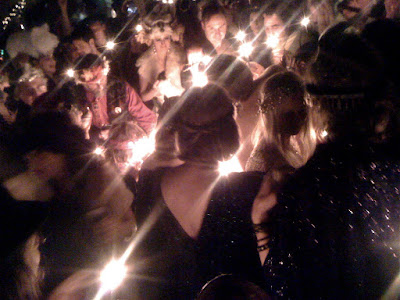

Around the time of the Winter Solstice, I tried this out on the grown-ups, saying things like, "This is as dark as it gets, now we can look forward to more light," or "It all gets better from here!" Most thanked me, accepting my invitation to look forward with hope, but many drew back in mock defensiveness, bubbling back, "I love the dark! I love the long night!" denying my assertion that there could be anything wrong. I understand that they were looking into the dark with the certainty of their optimism, wearing it like a shield against doubt.

Hope and fear are the two sides of this coin and both are legal currency in the marketplace of the future. There are those that claim that we create reality through our attitude, that if we anticipate success we make it more certain, while the same goes for failure. And I expect there is some truth to that, although probably a lot less than the pop philosophies would lead us to believe. In her book Bright Sided: How Positive Thinking Is Undermining America, inspired by her struggle with breast cancer, Barbara Ehrenreich, calls this faith in the determinism of attitude "the new Calvinism," seeing a world in which we are all ultimately and personally responsible for the evils that befall us, be it cancer or unemployment, casting every set-back as a personal failure, having nothing to do with the pernicious randomness of disease or outgoing tide of economic recession.

Optimism is a magnificent thing. I hardly think I'd want to go on living without it. Living hopefully does not call for optimism of the blind variety, but rather the eyes-wide-open knowledge that this sure as hell can work given what I know to be true about the world and myself. Optimism backed up by thoughtfulness, experience, and confidence is always justified, but when worn merely as a prophylactic against fear, it sets us at the roulette wheel feverishly spinning away, doomed to go bust no matter what our attitude.

Pessimism gets a bad rap and I understand that. Relentlessly pessimistic people are hard to be around unless they're able to temper it with a cynic's humor, and even that wears thin after awhile. But that doesn't mean that the fear at the heart of the pessimist isn't justified. It could always go wrong. The future is full of pitfalls: we count on our wary pessimists to point them out. Whose investment advice would you be more likely to take: the optimist or the pessimist? The pessimist's, of course, after all if he's willing to place a bet on the future, you can be darned sure he's done his homework and is not relying on the vagaries of "good thoughts."

Young children don't think in terms of optimism and pessimism, especially the very young for whom the future really doesn't exist, let alone with enough concreteness to evoke hope or fear. And sure, as they get older they quite reasonably adopt the cloak most appropriate for the occasion; dressing for instance in eager anticipation of the holidays or in fearful anticipation of the doctor's needles. Rational responses both, ones that belie the reality that the presents are rarely as incredible as one hopes nor the pain as bad as one fears: our attitude, be it hope or fear, not altering reality, but rather helping to temper our experience with reality in a way to prevent the highs from being too high and the lows from being too low.

I'm thinking of all this today on the first day of 2021 because as I reflect back on the ill-reputed year now past with all it's obvious downs and surprising ups, I can't help but think of the "curse" that is usually attributed to the ancient Chinese: "May you live in interesting times."

And indeed, I have been cursed; we have been cursed. The brilliance of this curse, of course, is that it can just as easily be a blessing, because really, who would want to live in boring times? And indeed, I have been blessed; we have been blessed.


I'm going to try this year, as a resolution, to approach the future more like a child, setting aside the dogmatism of optimism and pessimism. I will let my feelings flourish, learn what I can from them, then wearing them on my sleeve, I'll seize the day while worrying about tomorrow when it comes.

When I succeed, I will credit those who hugged me when it was dark. When I fail, I will shrug and not heap all the blame on myself, knowing that I have no control over the weather.

There is a companion curse that goes along with the famous one. It's one we habitually evoke for one another this time of year as a blessing, so take it as you will: "May your wishes be granted."

And in the meantime, however, I wish you a fine year.

******


I'm excited to introduce my brand new 6-part e-course, The Technology of Speaking With Children So They Can Think, in which I pull the curtain back on the magic that comes from treating children like fully formed human beings. This course is for educators, parents, and anyone else who works with young children. It's the culmination of more than 20 years of research and practice. I've been speaking on this topic around the world for the past decade and know that it can be transformative both for adults and children. For more information and to register, click here. Thank you!

I put a lot of time and effort into this blog. If you'd like to support me please consider a small contribution to the cause. Thank you!
Bookmark and Share