Saturday, March 05, 2011

A New Window Into Sensory Play


I've recently had my eyes opened to the terrific blog Sand And Water Tables by a veteran teacher from Minnesota who goes by the apt moniker Tomsensori. There's a lot more to explore over there, but the first thing I knew we must try at Woodland Park is the idea of carving up the sensory table with dividers. In Tom's case, he used one of our own favorite low-cost standbys, cardboard and duct tape, but since we'd been horsing around with our plywood play planks, I thought they'd be a perfect (and easier) alternative.


We tried them out first with the Pre-3 class in a table of coffee beans, although as you can see in the pictures I underestimated the kids' average height a bit, leaving them with wall they could easily see over. Not a big issue, really, but I'd been hoping to give the kids their own "private" work spaces with windows through which to interact with their friends. This miscalculation lead to a lot of exploration around the concepts of "over" and "on" as opposed to "through."


Even though I'd failed to create the exact environment I was shooting for, we still found it nice to have our own work spaces in which to experiment with the coffee beans in relative peace.


And there was still quite a bit of play involving the little windows.


For the 3-5 class, we augmented the walls with a few more boards, giving the various sections a more enclosed feeling.


There was still some "over" and "on" play, but the windows became much more of a focal point of the play.


The older kids also seemed to enjoy having their own sections in which to play.


Especially popular was this cramped little triangle area, which seemed to be hosting someone at all times, and even 2 or 3, often with the objective of "filling" the area.


At one point Connor explained to me how he'd made a waterfall by filling the small section, banking it up against a corner where the beans spilled out and into another section through a small gap between the boards. He was then collecting the beans with his shovel and returning them to the top of the waterfall. Several other kids wound up being pulled into his game.


We had coffee factories, construction sites and all kinds of over, under, through, and around play going on in there, not to mention the opportunity for more quiet, meditative moments than our sensory table normally provides. And there's a lot more to explore here, both in terms of the use of dividers and materials, as well as over on Tom's blog. What a great new window into the world of sensory play.


Bookmark and Share

Friday, March 04, 2011

My Brain Just Isn't Big Enough


I tell people all the time that I could never teach in a traditional preschool, the kind with one or two teachers and a bunch of kids. My brain just isn't big enough to be anywhere other than a cooperative. I need the smarter people around to help when things get stuck or otherwise mucked up. 


This is a popular toy at Woodland Park. I know it looks like a weapon, but it's not. It's a "bow and marshmallow," a tool designed specifically to feed those small puffy treats to giant babies.


You fill the tube with small marshmallows, then draw back the string the way you would with a bow and arrow and let fly, hopefully hitting your target, which is the wide open mouth of afore mentioned hungry baby.


We've never "taught" the children of Woodland Park to stand in line, much to the chagrin of field trip tour guides who ask this of them, but they naturally queue up for their chance at this.

On Wednesday we had a grand old time firing away at our target, leaving the ground white with marshmallows which the crows gladly cleaned up for us overnight. I then stupidly left the entire bag of marshmallows outdoors as well, under cover, wrapped up tightly, but this is Seattle and I guess some of our famous humidity found its way into the bag, making our baby food slightly sticky yesterday morning. Not uniformly sticky, but enough I guess that it caused the "bow and marshmallow" to misfire with frustrating frequency yesterday.

Isak's mom Leslie was serving as ring master for this particular activity and at first she called me over to help unjam it. My technique was to bang it on a table and repeatedly shoot the thing until a marshmallow came flying out, then hand back to the next kid in line, who was disappointed when once more the marshmallows got stuck. We went through this process several times, before Leslie recognized the symptoms of insanity (doing the same thing over and over, expecting different results) and said, "They're too sticky. Maybe we should roll them in flour or something."

We always have flour with our play dough making supplies so I retrieved some, turning a bag of flour and a bag of marshmallows over to the kids to mix together. 


I felt confident this would work and moseyed over to the sand pit where a group of diggers were hard at work clearing a channel through which water from the cast iron pump could flow. Before long, behind me, I again heard the sound of the bow and marshmallow back in action.

It was the coolest thing, not only was the baby once more getting fed with flour-coated marshmallows, but each shot from the bow produced a dramatic cloud of flour "smoke" as the projectile found its way into that wide opened, developmentally inaccurate, toothy mouth. How exciting! Genius! 

I'm pretty sure I remembered to bring the apparatus indoors last night . . . Oh no I didn't. But Leslie did.

Bookmark and Share

Thursday, March 03, 2011

The Dolls I Bought For Sasha


If you've ever had Barbies in your house, you know that they spend most of their lives naked. At least my sister's did, as did my own daughter's. The point of the Barbie doll, I foolishly thought, was to own one or maybe two, then to acquire new outfits for them that were continually traded out. You know, like with real people. 

I was quickly to learn as a parent, however, that this was not the case. The shape of the Barbie body, the stiffness of the limbs, and the tendency for all those little fingers to get hooked up in everything, made dressing these cartoonish characters nearly impossible for little hands. If they were going to get dressed, it was going to require either adult assistance or a very persistent child. And once that outfit was off, and it happened with regularity each time a friend came over to play, it tended to stay off.

Personally, I do not object to the Barbie doll. I know it's supposed to somehow create unreal expectations of unattainable beauty for little girls, but I don't buy it. The Barbie, to my mind, is just another princess, a powerful figure in the lives of many little girls, an exaggerated expression of our society's idea of femininity, one that plays into a preschooler's developmentally appropriate exploration of the extreme manifestations of the stereotypes of her gender. Playing with Barbies is no more an indicator of a future as a superficial bimbo, than playing with Star Wars figures is a predictor of a little boy growing into a violent bully. All the research shows that those futures have almost everything to do with the values and behaviors of a child's parents.

That said, I didn't want to have the argument at Woodland Park, so when I thought 9 years ago that it would be fun to have some dress-up dolls around the classroom, I went for a set that represents slightly older children than the ones I teach in the hopes that they would still bear with them the shine of being aspirational, without having to deal with the adult objections to giant breasts, waspish waists, disproportionate legs, and poofy hair. They have been, in a word, resounding flops. They come out every year, they do manage to get naked, then they get scattered around the floor, walked on, tripped over, and otherwise neglected.

This week they've been engaged in their annual festival of neglect and humiliation, until yesterday when I noticed Sasha, alone, playing with them.

"Sasha is playing with the dolls," I said, working on my descriptive (or informative) speaking.

She was wrestling with a tiny windbreaker with an itty bitty zipper. She handed the jacket and doll to me, "Teacher Tom, will you help me?"

"Sure." I took the windbreaker and wrapped it around the doll, laying it on the floor as a sign of completion.

"That's not the right way."

"It looks right."

"It's not." She then very carefully pulled one sleeve up a stiff arm, picking the individual fingers free when they got caught up in the nylon one by one, repeating the process with the second sleeve, patiently manipulating the arms into an angle that worked for her process because the second arm is always more challenging than the first.

I said, "You put it on."

She handed the doll to me again, "I can't do the zipper."

I got it started for her, showing her how to insert one side into the other, then handed it back saying, "You can do the zipper now." She did.


Sasha then proceeded to clothe all the dolls in the basket, carefully, meticulously, using the tips of her fingers to manipulate those little socks and shoes, leaving only the zippers open, no longer turning to me for help. In fact, I shut up entirely and just sat with her, given that my previous forays into conversation had resulted in requests for unneeded assistance.


I'm glad I had the insight 9 years ago to buy these dolls for her.

Bookmark and Share

Wednesday, March 02, 2011

Inventing Us


The opposite of play isn't work, it's rote.  ~Edward Hollowell

This might sound like an odd thing for a teacher to write, but I sometimes get the idea that knowing stuff is the enemy of education. There is little gratification in it for me when I've envisioned how children will do something, then they proceed to do it in just the way I've imagined. Certainly I could claim it as some evidence of experience on my side, but it also makes me worry that it's also evidence of rote on the children's side. 

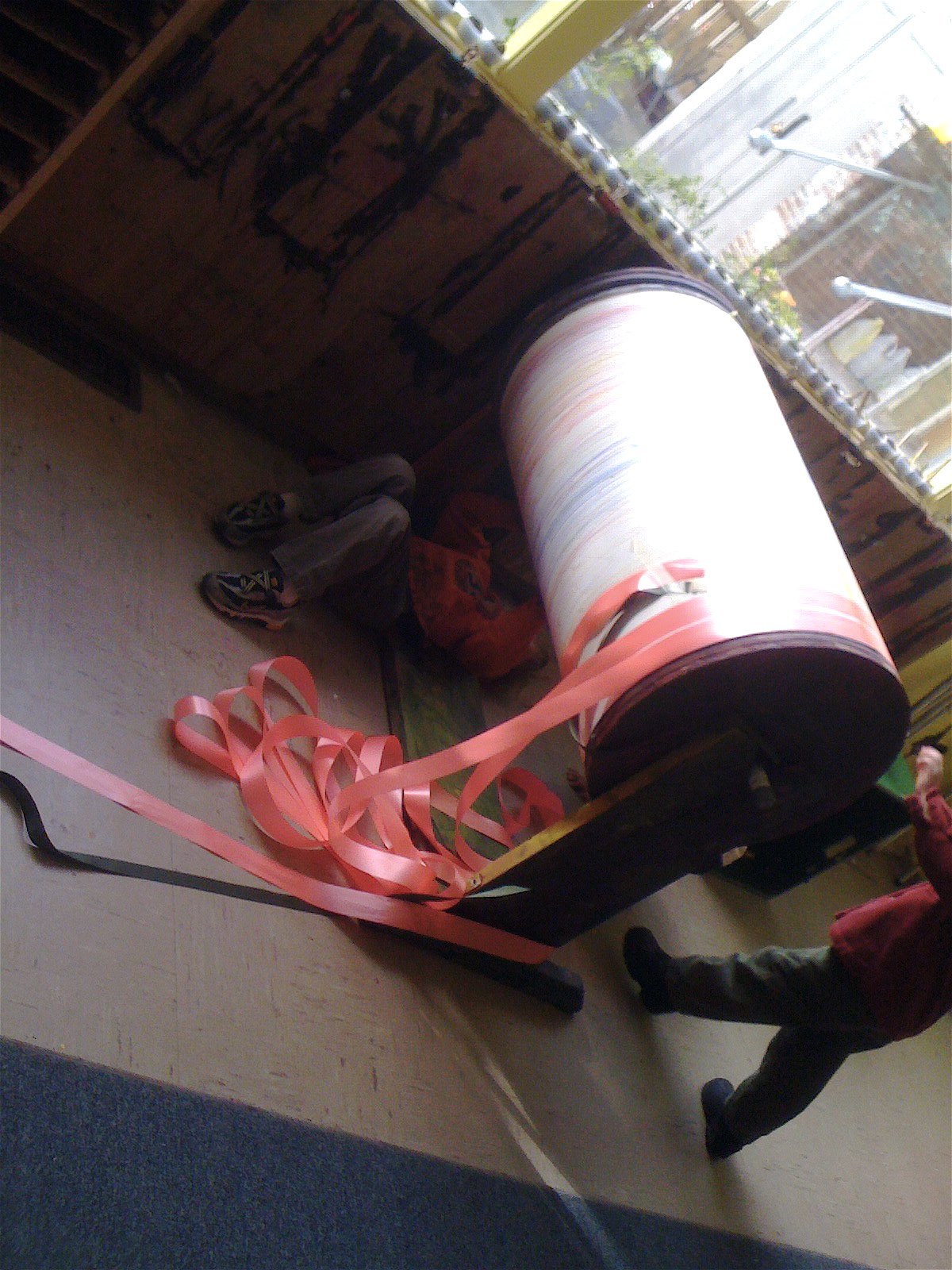
We haven't had the spinny barrel thingy out for awhile. I taped a few lengths 
of fabric ribbons to it. 

I'll let future teachers worry about teaching the kids to follow instructions if that's what they feel they need them to do. Much better things are happening in our school, it seems, when instructions are minimal and I'm constantly proven wrong in my expectations. Fortunately, when working with young children in a play-based environment, that's more the norm than the exception. 


Our classroom, every day, should be one big experiment, a place where things are not known by either the kids or the teachers, a place where we fiddle and argue and poke and prod our way toward knowledge, and where everything we come to understand is only a part of all the other things we're striving to know.


It should be a place with lots of room for failure, frustration, and conflict. It should be a place with lots of room for wonder, epiphany, and friendship.


When a reporter asked Thomas Edison how it felt to have failed over a thousand times in his quest to invent the lightbulb, he famously answered, "I didn't fail a thousand times. The lightbulb was an invention with a thousand steps."


Except we're not even trying to invent anything here, but simply discover, in the spirit of pure science conducted for the purpose of getting closer to our own truth and nothing more.


Or maybe we are trying to invent something, after all, and if we are, it's not the sort of thing that can be put into words, but rather felt or intuited. I suppose it has something to do with inventing ourselves both as individuals and as a community.


It's something that can only be invented by conducting thousands and thousands of experiments; by taking thousands and thousands of steps.


And even though billions of humans have come before us, if we are playing together, we are discovering and inventing a thing that has never been discovered or invented before: us.


Anyone who tells you they have a system or method or sure-fire technique for educating children isn't talking about education at all. They're talking about standardization and efficiency. They're talking about assembly lines and cookie cutters. Anyone who doesn't start with the idea that it's all an experiment isn't talking about education at all.


They're talking about rote.

Bookmark and Share

Tuesday, March 01, 2011

The Problem With Right And Wrong Answers


When I arrived at Woodland Park 9 years ago, I inherited a well stocked classroom although I didn't know it at the time. To me all the toys, games, manipulatives, and puzzles looked old and worn, and there appeared to be a lot of junk mixed in with the good stuff. For my first couple years I was only teaching the 3-5 class, sharing the classroom with another teacher, and both of us were reluctant to toss anything out of deference to one another. We kept talking about meeting up some weekend to make some joint decisions, but it never happened.

I've tried to be brutal over the years since, purging things from our shelves and closets that we never use, but there's still a lot, and now, sadly or gladly, I've added to it. 


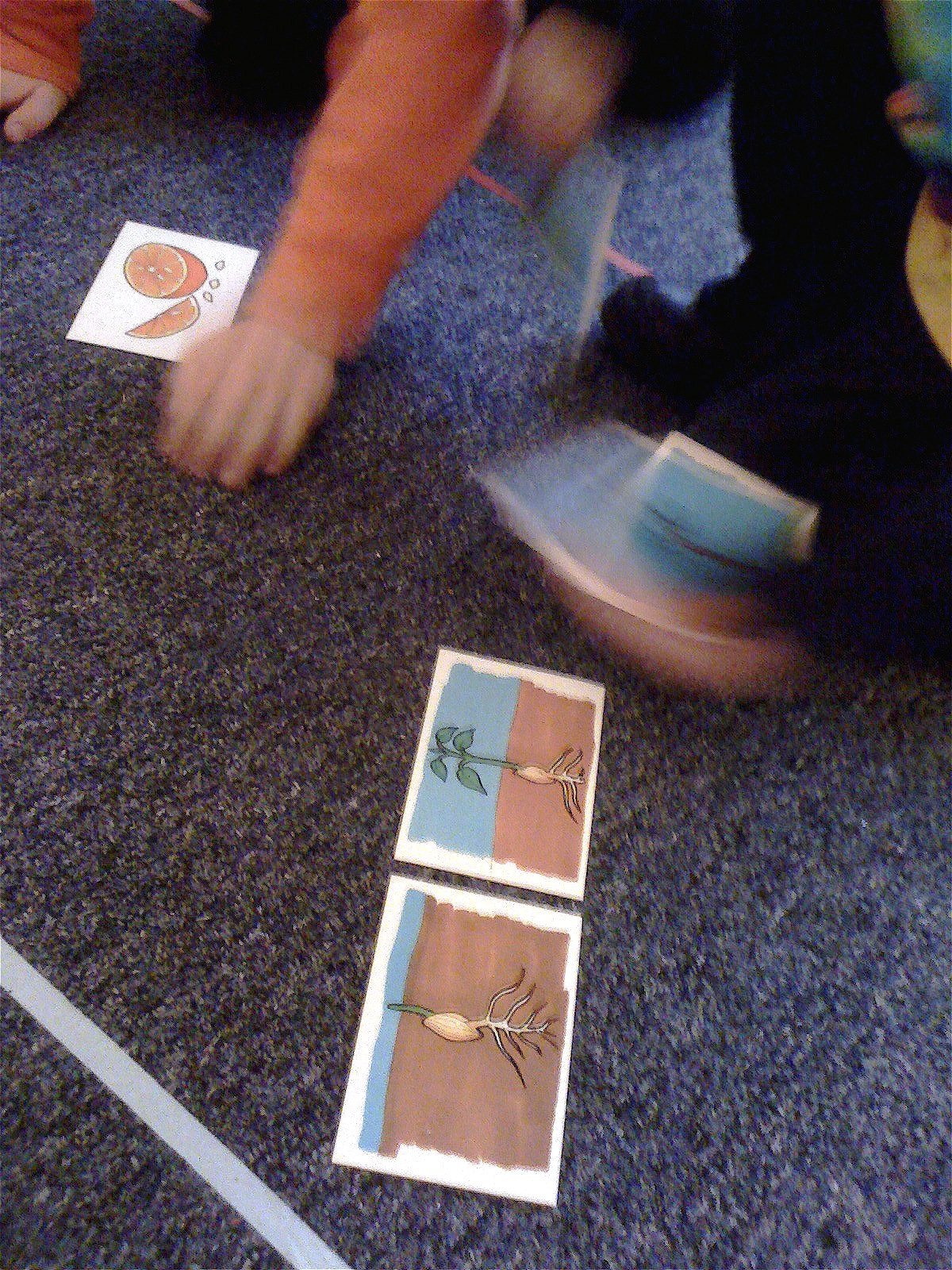
One of those inherited items, not tossed in one of my binges, largely because it seemed to be complete and didn't take up much space is this set of "Life Sequence" cards from Lakeshore. There's the one in the picture, a baby becoming an old man, as well as a seed growing into a tree, an egg hatching and becoming a duck, a tadpole becoming a frog, a caterpillar metamorphosing into a butterfly . . . There may be a couple more, but you get the idea.

What I tend to not like about these kinds of things is the temptation for me as the teacher to insist on the right answer. I introduced them by calling them "story puzzles." Don't ask me why, but it's what popped into my head when I was trying to find a way to define the word "sequence." And for a time this worked as a useful name for them.


Lachlan, for instance, was working on the orange tree sequence. He started with the seed, then the sprout, then the sapling, then the full grown tree. He was left with a picture of the whole orange, sliced to reveal the seeds. I was waiting to see at what end of the sequence he would place it, because after all, either end would work.


Instead, he tossed it aside, saying, "That's it."

I asked, "What about the orange?"

He looked confused so I walked us through the story the pictures told, "First there is a seed in the ground that grows roots. Then it becomes a sprout. Then it becomes a little tree. Then it becomes a big tree. Then . . ."

"Then that's it," he finished for me.

"Well, what about the orange? I see oranges on that big tree."

"Teacher Tom, those aren't oranges, those are apples!" It's hard as an adult, who knows the "proper" sequence because he's seen the numbers on the backs of the cards, to keep his mouth shut, but this time I did. After all, he was right, you don't get oranges from an apple tree.


Shortly thereafter, I watched Peter put together this sequence. I tried the same technique I'd used with Lachlan.

"Okay, let me see how your story goes. First he is a teenager, then he is a daddy, then he is a baby, then he is a boy. That doesn't sound right."

Peter answered, "It isn't right. It goes like this, first there is a little man, and he meets a big man, and they find a baby, and they give it to the boy. The end."

Later, Isak discovered the numbers of the backs of the cards that dictate the "proper" order. After he'd taught his friends that shortcut, they made short work of the cards, no longer caring about the pictures on the front or the stories they could tell with them. They then dispensed with them as quickly as a middle schooler who discovers the homework answers in the back of the book, and moved on to something else.


I guess I'm glad I saved these cards, but they're too much of a one-and-done kind of proposition to really deserve a share of the limited space on our shelves. As long as we were telling stories, the kids were engaged, but the moment they became about right and wrong answers, we voted with our feet. 

To their credit, the cards don't take up much room so I'll keep them. When I get them out next year, however, I'll make sure to black out the numbers on the backs.

Bookmark and Share