Tuesday, November 23, 2010

It's Not Wasted


Some people are surprised to learn this, but Seattle is not snow country. Sure, a half hour drive into the Cascade Mountains will bring you to ski slopes, but snow on the city streets is a once every few years kind of event. This is a good thing given that we're a city built on hills and connected by bridges. Transplants from snowier climes mock us for our timidity about doing things like driving in the snow, but I've lived in the Detroit area -- it's flat there! Anyone can drive in the snow if you don't have a negotiate hills and bridges.


When I left the house yesterday, there were flurries in the air, just as forecast. By the time I got to school there was some accumulation, which was the extreme end of what the weatherman predicted. As school time approached, it was really coming down, and becoming evident that it was a snow day.


I know it doesn't look like much in these pictures, but I took these before seeing the heavy garbage truck fishtail down the hill in front of the school, and the snow kept coming, all day long, combined with temperatures in the 20's, another rarity around here, especially in November. When the wind kicked up in the evening, reaching 72 mph in some places north of the city, the wind chill factor dropped us to 7 degrees F. That's cold by anyone's standards.


It's not wasted, of course, I've already seen dozens of photos of Woodland Park kids romping in their backyards and parks close to home. We'd already decided to close school today before going to bed last night, another day for the children to throw snowballs, lick icicles and build snowmen. 


No, the snow day is not a wasted day, even for my teenager who will probably use it as an opportunity to sleep until noon. It's not supposed to get anywhere near warm enough today to melt the ice on the roads, and while I may hazard a drive to the grocery store, right now I'm planning the 1.5 mile hike to retrieve the 25 lbs. turkey I've ordered for Thanksgiving, bring it home, then set back out on a second trip to do the rest of the holiday shopping. Old school, baby.


After that, who knows? I might just spend the rest of the day trudging through the stuff, working up a mighty appetite.


In the meantime, this morning in my jammies gives me an opportunity to catch up on stuff, like checking out the video of my friend Tiberio's recent TEDxRainier talk. He's a remarkable, passionate, playful man, who has lived a life that might have crushed a lesser human. If you've ever wondered about the costume I'm wearing in the photo at the top of this blog, I blame Tiberio. He was the one who first envisioned a team of superheroes roaming the world giving out hugs and spreading love

There is a bit of nudity in the video, just a warning . . . or perhaps a snowy day enticement. 


Bookmark and Share

Monday, November 22, 2010

Winding Up Kids


On my first Monday in North England (where I was to take part in the EarlyArts International UnConference), I had the opportunity to visit the preschool located in the Eureka! National Children's Museum in Halifax. Not only are these kids lucky enough to attend school at an award-winning museum, but the school itself is located in the former Victorian Station Building and the current location of an active train platform right outside their window. Holy cow! What kid wouldn't like that!


The idea of my visit was to tour the facilities, visiting the classrooms, playing with kids, and talking with teachers, then to lead a "training session" with the whole group at the end of the day.

The plan was for me to start off in the infant room, then work my way up through the "preschool," which is where I'd meet the 3-4 year-olds. 


The school has the high ceilings of a Victorian era train station and thankfully they didn't feel the need to pop in an artificial ceiling or build solid walls, opting instead to divide their long, well-lit space with half-walls. Mondays are apparently not their busiest days, so there weren't a ton of kids, and it was fairly quiet as I made my way from age-group to age-group, asking questions, but mostly just playing with the children. I did notice, however, that at each stop the sound level rose a little, not from the "room" I was in, but farther on, up where "the big kids" hung out.


By the time I got to the room with the 2's and young 3's there was a line of fingers and eyeballs across the top of the dividers. The "big kids," anticipating my arrival in their room, were peering over to get a peek at this curiosity making his way toward them. There was a lot of giggling.


When I got to their room, however, it appeared vacant at first, and suddenly quiet. They were hiding from me, but not for long as first one, then the rest of them burst from their places, squealing and shouting. I'm not sure what they'd been told about me, if anything, but they certainly were expecting me. And they were plenty wound up.


I was to later learn that male early childhood teachers are still a rarity in this part of England, which sort of explains their response, one that I received to one degree or another at every school I visited. I've written before about how I'm not entirely certain what people mean when they say "we need more male preschool teachers," but I do know that the important men in many children's lives (fathers, grandfathers, uncles) are much more likely than the important women to rough house and generally play wild, high-action, high-volume games with them. I did it with my own daughter (wrestling, lava monster, tickle attacks) and still do it with my several nieces and nephews, but it's not something I'm interested in doing as a teacher -- I'd spend my entire day in a pig pile if I did.


The entire preschool group then gathered around me, I had their full, giddy attention. I asked them to show me around their classroom, asking about where they built with blocks or played dress-up. As a group, they showed me where they painted, I sang a couple songs, we goofed around with some toys, but it was clear that I was the toy of the moment and before long I received my first friendly hit. That's right, a full-armed swing at me, executed joyfully by a girl in a Cinderella dress. The next whack came shortly thereafter and soon I was ducking under a hail of tiny fists.


I said, "I don't like to be hit. It hurts me." The hitting stopped, but I could tell it was only a temporary pause unless I took advantage of my opportunity. "I like to play gently. I want to play a gentle game with you."

One of the boys answered, "We could stroke you," and those little fists unfurled to pat and pet my arms and torso. Before I left, I was again subjected to a bit of good natured pummeling, but I escaped in one piece.


The following day, at the conference, I ran into these preschool kids again, this time a the Square Church where the conferees were gathering for a performance of A Smile is a Bridge from Ear to Ear, a production the Tell Tale Hearts Children's Touring Theatre Company. I'm not very bright sometimes and as I caught sight of them sitting on the floor together with their teachers downstairs from the theater it did not occur to me that they were waiting to see the performance. All I knew was that I'd spotted my new friends and this time I was going to take the initiative and show them how to have a wild old time without hitting. Oh I wound them up, pretending to be a giant among other things.

It wasn't until I got into the theater and saw Becky, the Eureka! Nursery director, sitting on the colorful mats on the floor in front of the audience that I realized what I'd done. I said, "I'm afraid I wound them up pretty good." She answered something to the effect of, "Thanks a lot." The school had come with an adequate supply of teachers, who I recognized from Monday evening's training session, but I figured I owed it to them to stand by as reinforcements just in case things got out of hand, so I took a seat on the floor with the audience at my back.


My worries were unfounded, thankfully, as the kids were absolutely transfixed by the show, one of few words, lots of simple clowning with boxes, tubes and cardboard, and themes of sharing, play, conflict, and cooperation that were spot on for the age group.

The best part of the performance was its ending, when the two performers carried their props to the children, set them on the floor and said, "For you."


At first these kids, who had so recently been on the verge of shrieking and pummeling, sat in a kind of stunned silence, not sure what to do, but as the performers brought more and more boxes and tubes to them saying, "For you," the children began to play. For a brief moment some of them were distracted by the adult audience responses, but soon, especially once the actors joined them on the floor to play with them, they blocked us out entirely and got on with the job of childhood.


Bookmark and Share

Sunday, November 21, 2010

I'm A Curriculum Planning Genius


My wife and I like our brussels sprouts and lately our local grocer has been selling them bundled in green plastic mesh bags, which are not the kinds of things middle class bag ladies throw out, so a fistful of them came to school with me a few weeks ago. As I juggled stuff to unlock the door, I must have dropped them on the ground in the outdoor classroom, forgetting about them entirely until they turned up as a central element in one of the children's games.

Honestly, I can't recall what the bags represented for the kids, but wearing them over your head made you some sort of character that was involved in the capturing (or perhaps recruitment) of monsters. Or maybe it made you a monster -- something like that.


And because I'd eaten my veggies and accidentally dropped these bits of refuse (which otherwise probably would have found their way into the collage box) we got several solid days of intensive dramatic play centered around our homemade playhouse and a random ball of yarn from a project undertaken months ago, left behind, and recently re-discovered.


I'm pretty sure the yarn was intended to keep monsters out, but again it was their game, they didn't appear to be treating anyone unkindly, so I did what every adult ought to do, made like a monster and kept out of it, which explains why I really don't know.


This game, which took place over the course of many hours and several days, involved about a third of the kids and tons of sentences that started with the real magic word: "Let's" (e.g. "Let's pretend . . ." "Let's make . . ." "Let's find . . ."). It was a game with rules we adults cannot fathom, an aesthetic we don't get, and a trajectory as unpredictable as real life.

My second recent stroke of genius in planning a play-based curriculum was having parents who, while waiting for our 3-5 class to return from a field trip, worried that the gusty wind was going to carry away our portable canopy, so they employed the telescoping legs on the thing to lower it out of the direct wind.


Before the Pre-3 class arrived the following day, I contemplated raising it again, but got busy with something and forgot all about it. This was the second time in a very short time span during which I revealed my curriculum planning genius through the simple act of forgetting.

Upon discovering this apparatus thus transformed, the children crowded around, fascinated with being able to touch the roof, stretching their bodies and standing on toes to reach it. It didn't seem quite fair when a few of the shorter ones were unable to reach it, so we brought out a step ladder.


Some just climbed to the top, touched the canvas, then climbed back down. Others carried up cars or ballerina figures to drive or dance up there. One guy took the chance to give the canopy a good sweeping.


Others just hung out, enjoying the view. 


It only took a few minutes for adults to help them get the idea of one-at-a-time and not pushing. 

So listen up all you young teachers out there, that's how you do planning for a play-based curriculum: forget about things then take credit for what the children do with your mistakes.

And for anyone who wants/needs to know what is really going on when children engage in this kind of unstructured play (with adults only stepping in to help when things get unkind or potentially dangerous) here's a terrific video from Dr. Christine Carter of the University of California, Berkeley's Greater Good Science Center. I was particularly struck by what she has to say about the impact of unstructured play, or lack thereof, on emotional regulation.


Bookmark and Share

Saturday, November 20, 2010

How To Clean A Dirty Sensory Table


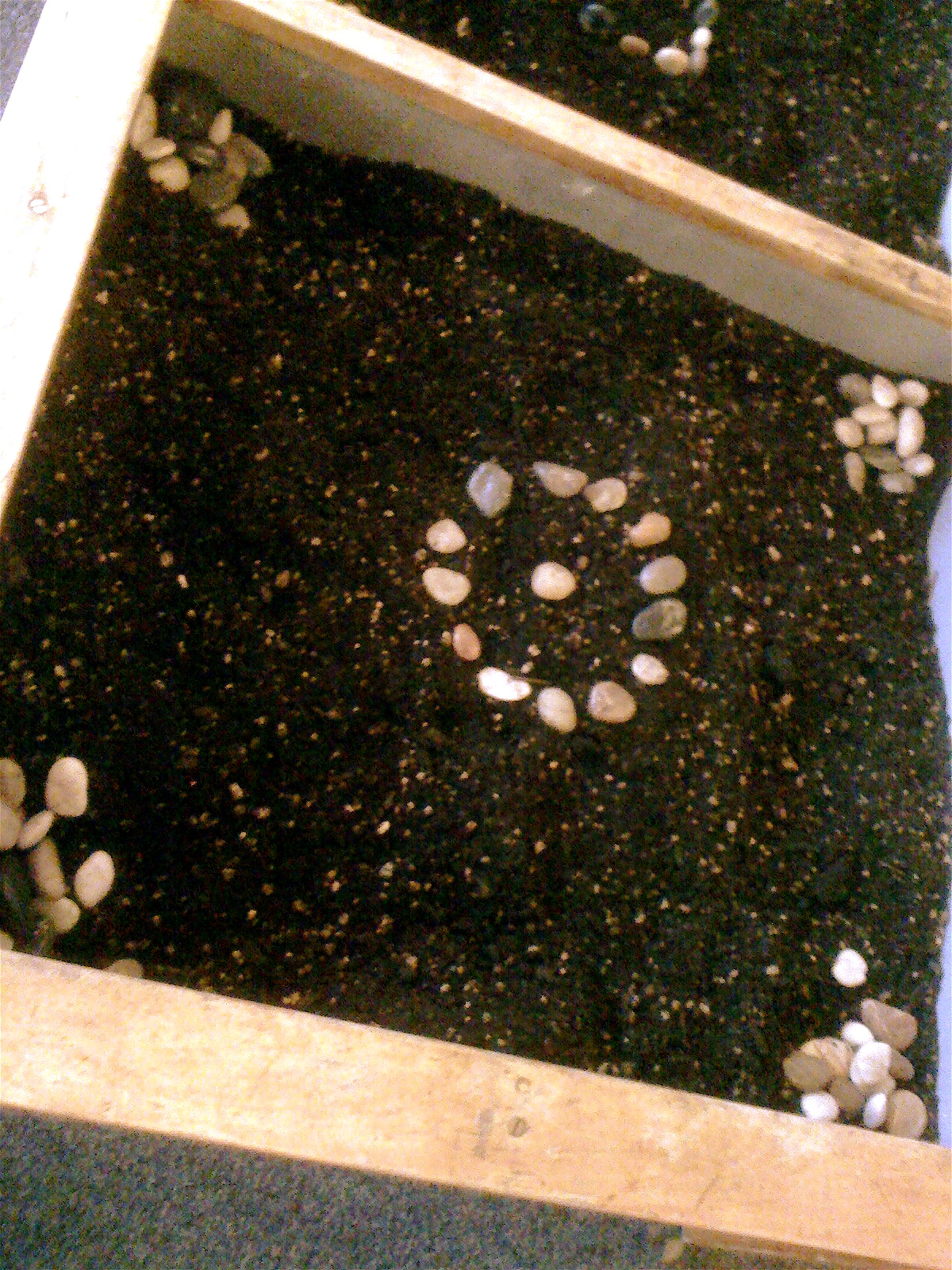
During my week away from class, we'd had potting soil, pots, and artificial flowers in our sensory table, but since we had so much going on in the other parts of the classroom during my first week back, I thought we'd just leave the soil where it was, adding a few river rocks with the idea of creating a sort of quite Zen garden-like retreat for kids who needed a little break from the action.


I thought it had a kind of simple beauty to it.

Either I'd misjudged their need for an oasis or it was just a bum idea, but whatever the case the kids more or less steered clear of the sensory table, stopping by only to quickly destroy whatever pattern the adults created before moving on. The only way I found to attract the kids to the area was to use the the stones and dirt to tell stories, which was great, but not really what I had in mind.

I stuck with it until Wednesday thinking that the lack of engagement might just be one of those flukes of the preschooler hive mind, but by the end of the day it was clear that this one was exhausted. The kids removed the stones and we wheeled the sensory table outside where we provided shovels and declared we needed to get this good soil out to the garden.

This is when the action finally began. Jasper's mom Leslie took on the role of "coach," inspiring a team of girls (mostly) who scavenged pails from the sandpit, creating a kind of bucket brigade to the garden where Jody's mom Jennifer (a master gardener) directed this late fall soil augmentation. 

And it didn't stop there, soon the table was on its side as a pink coated team finished the job of cleaning out the sensory table with brooms. I love nothing more as a teacher than to see children form into teams to accomplish an end. This ability to work with others, more than any other thing, is the skill most predictive of living a satisfying life.


And while they did a magnificent job, there was still a residue of soil in the table. My usual strategy is to let the kids unknowingly finish the job of cleaning the dirty table with a day of water, their swishing and splashing serving to completely wash it out. I tossed the river rocks back in for good measure.


That simple switch from dirt to water was all it took. The 2-year-olds kept our good, old sensory table company for the entire morning.


And now the sensory table is clean.

Bookmark and Share

Friday, November 19, 2010

For Everything Else We Use Tools


If the only tool you have is a hammer, you tend to see every problem as a nail. ~Abraham Maslow

Yesterday, as I waited for the children to assemble at school before we set out for an adventure-packed field trip (the bus broke down and we had to walk part of the way), I was salvaging zip ties. It turns out that about 25 percent of our bamboo cane fort had been assembled using ties that had been installed "backwards," meaning that they weren't particularly effective in holding the thing together, but on the plus side, they were rendered reusable.

Dennis was the first to arrive. He's been one of the driving forces in our den construction this week and in explaining what I was doing mentioned that maybe next time we'd try using wire instead of cable ties. He answered, "I can twist wire."

I'd been inspired in my own thinking by this simple post from my blog friend Anna Golden, a fellow artist and preschool teacher, in which she points out the importance of children learning basic technique and skills to support "student-driven inquiry." I'd been thinking along these lines all week as we learned to use zip ties, no simple thing really, as Juliet Robertson, another blogging friend, pointed out in a comment. Judging from the results so far, we're still only 75 percent of the way toward "mastering" that tool.

Anna talks about technique and skills, whereas I tend to talk about using tools, but it's the same thing. Humans are driven to use tools to imprint their visions on the world. Almost everything we make or do involves, at some level a tool, the mastery of which requires practice. In preschool, we need ample opportunity to sort of mess around with a wide variety of tools like wire, scissors, hole punches, hammers, paint brushes, saws, glue guns, pencils, screwdrivers, knives, and paper clips. We need to get our hands on brooms, clothes pins, drills, shovels, rulers, pulleys, trowels, staplers, and rakes. As humans we have being alone, we have talking face-to-face; for everything else we use tools.


Any tool is a weapon if you hold it right.  ~Ani DiFranco

As teachers, our job when introducing a new tool or skill is to find that crucial balance between free experimentation and demonstrating proper technique. Tools are inherently dangerous, they all have a dark side, a potential for injury if misused, the basic kitchen knife being a classic example, but even a piece of paper can cut. A humble paper clip if inserted in an electrical outlet can have disastrous results. Sometimes we have to let children learn about that dark side through their experimentation, such as by hitting their fingers with an ill-aimed hammer or burning themselves with a glue gun in a moment of inattention. Sometimes we need to protect them, such as with the paper clip and the electrical outlet, because of the potential for grave injury or death. But most of the time we must accept that pain is part of the trade-off for benefiting from tool's power -- ask any secretary if it's possible to avoid paper cuts 100 percent of the time.

 
Anything you can do needs to be done, so pick up the tool of your choice and get started. ~Ben Linder

Every day, in every corner of every classroom, all around the world, children are using tools, developing proficiency, learning through their successes and their mistakes, bringing their unique vision into the world through both pain and joy, preparing themselves for a life of inquiry. They are all tools of creation, awaiting the human being to pick them up and get started.

The future always belongs to the tool user. The more tools you can use, the better that future will be.

Bookmark and Share

Thursday, November 18, 2010

A Light And Dark "Den"


As our younger children joined the older ones in adding to and enhancing our The Den Experiment experiment, quickly learning the technique of building with bamboo cane, zip ties, clothes pins and fabric, in the far corner of the room another kind of "fort" was taking shape.


At the UnConference I met a puppeteer named Alison McGowan (she doesn't seem to have a web presence or else I'd link to her work) who is doing incredible work with young children, using a darkened room and every day translucent and shiny objects along with many of these little "push lights" . . .


. . . to create magical interactive spaces of light and shadow. Now we don't have the luxury of a whole room that we can darken at Woodland Park, but I thought we could create a mini-version by closing off the bottom of our loft with a piece of orange felt.


We already have mirrors under there. We added an old opaque projector with a light bed that can be opened and closed, then a few push lights, and a collection of objects that we thought would interact well with the light sources.


Under the lower part of the loft, we added several electric tea candles. When 2-year-old River first peeked under there, his first reaction was to say, "hot." It took him awhile to realize they weren't real candles.


I figured there would be a great deal of crawling in an out, but I'd underestimated the draw this new space would have for the kids. There was almost always at least a half dozen kids under there during the whole of our free play time. There was no way to get my big adult body in there for photos!


Alison uses drinking classes, plastic funnels, shiny beads and all sorts of other items in her work. Time for a bit of scavenging.

Bookmark and Share