Tuesday, September 21, 2010

Getting Boys To The "Art Table"


As a boy I made a lot of art. Mom kept pencils and paper in her purse at all times. That and Lifesavers is what she tended to offer us when we got squirrelly in non-squirrel friendly venues. I remember spending entire sermons drawing what I called "Funny Faces," which were attempts at drawing people that featured heads with faces, arms, legs, but no torso. I knew something was "off" with these attempts, but for the life of me I couldn't figure out what I was leaving out, hence the name. I recall drawing, coloring and painting for hours on end, but that entire experience was limited to the venue of hearth and home.

I don't know if I would have spent time making art in preschool because, like all the kids on my block, I didn't go to preschool. And my kindergarten was the kind of place where art projects were handed out to everyone at the appointed time and we all followed the teacher's instructions. If memory serves most of these projects involved coloring, and even then we were told to always color side-to-side, not up and down or, heaven forbid, in circles. I have absolutely no memory of art being part of my formal education until I reached middle school where I had a cool, hippy teacher who let us listen to our favorite radio station while painting with oils.

All that to say, I don't know if I would have been one of those boys who regularly frequented the art table at Woodland Park or not. There are always a few in every class, but they are far rarer than girls.

Yesterday, for instance, we were making our snack table place mats, which we will use all year. It's basically a freeform art project involving bingo dotters, markers, and stickers, followed by getting to run your finished piece through the laminator. The table was slammed with children from the start. It didn't really pop out at me that there was a gender imbalance, but sure enough, as time started to become short, we were mostly chasing down boys to get them over there to at least put a dot on a piece of tag board to call their own.

This isn't just a Woodland Park phenomenon, of course, boys as a gender are notoriously averse to sitting down and making art, although we all know that activities like painting with vehicles, fly swatters, or rolling balls will tend to attract more of them. In general, I've found, that boys are going to be more attracted by processes that keep them on their feet and move their bodies.

That's why I was interested to notice how many boys were sitting down, yesterday, to play with this little play set.


We have four pieces of cork, tiny hammers, tiny nails, and lots of colorful shapes similar to traditional pattern blocks. The shapes have pre-drilled holes in them, so the kids only need to hammer hard enough to get the tiny nails into the cork. In the past, in spite of the inclusion of construction tools, this has remained an activity dominated by girls; girls who very often and very quickly figure out that they can eschew the tiny hammers and instead just push the nails into the soft cork like thumbtacks.

But this is the first time this toy has made at appearance since we introduced our outdoor construction station 6 months ago, with it's plenitude of real hammers and nails. I can't say for sure that there's a connection, but I'm having a hard time thinking it's a coincidence that this activity was suddenly popular amongst the older boys who have the most experience using the real things.


And not only that, but their play was sustained, artistic, and clearly undertaken with end results in mind.


Not only that, but they tended to stick with the hammers throughout, carefully positioning and tapping those tiny nails, demonstrating excellent fine motor abilities, patience and concentration.


Of course, this wasn't "sold" to them as an art project, so that may have had something to do with it. (I know last year, Jack wouldn't go near the art table until I moved our art projects to a different table and called them "math" projects -- then he was all over it.) But, this isn't this toy's first trip to the rodeo and it is the first time I've seen this level of concentrated involvement by our boys. It may have been a fluke, but I'm keeping an eye on it. I'm hoping that this is more evidence of our new outdoor curriculum making changes in how and what the children are learning.

Another theory I'm working on proving or disproving early in this school year is the notion that art activities that don't normally attract boys when undertaken indoors, will be more appealing in an outdoor venue.

Yesterday, we took the clay outdoors and while I didn't really notice a particular surge of boys, I was pleased to see that Orlando, normally not one of our most avid artists, having a ball playing with the "mud," as he correctly called it.


I will have more to report as the experiments progress . . . And now to start working on schemes for getting more girls into our block area without turning off the boys.


Bookmark and Share

Monday, September 20, 2010

"Everybody Sit In Some Broken Glass"


A couple days ago, I posted about some of our beginning of the year circle time songs. Several people asked me about the song I use to signal it's time to take our places on our blue rug for circle time, and specifically asked about more of the additional verses we've made up over the years.

I didn't include most of them on the first go-around for a reason -- that reason being that I'm not sure I should admit we sing these verses in preschool. I doubt they're right for everyone, but Woodland Park's institutional memory (carried forward into each new school year by the returning students) is such that I have no choice but to keep singing them now that the genii is out of the bottle.

To recap from Saturday: when it's time for the children to assemble on our blue rug I start with this song, which I learned from my daughter Josephine’s kindergarten teacher:

Not on the ceiling
Not on the door
Everybody find a seat on the floor.

And since it sometimes takes awhile for everyone to assemble, over the years, we’ve added some of my own verses to keep from having to sing those same 3 lines over and over:

Not on your feet
Not on your knees
Everybody sit on your bottoms please.

Not on your back
Not on your tummy
Everybody sit right on your bummy.

Not on your head
Not in a bed
Everybody sit on your bottom instead.

Keep your hands to yourself
Sit in your own self-space
I expect everyone to stay in one place.

Raise your hand
If you’ve something to say
You don’t get to talk any other way.

There are even more verses, and they change over time, but each one was created in an ever-escalating effort to focus an unruly group of kids. It's a moving target because, let’s face it, unless constantly refreshed the novel silliness of not sitting on the door wears off rather quickly, and is soon not nearly as entertaining as Henry’s efforts to turn a summersault or Sophia’s hot whisper in your ear. Each time I introduced a new verse, I bought myself a couple of days of attention focused where I want it at circle time – on me – but it never lasted and I was forced into creating newer and newer verses until one day I hit on this one:

Not on your fingers
Not on your toes
Everybody sit on a thorny rose.

When I realized what I’d sung, I spontaneously stood up slightly, hands on my bottom, and said, “Ow!” And the kids laughed. The next day, several of them requested, “The thorny rose,” so I did it again, and this time a bunch of them imitated me. By the third day, most of the children were raising their little bottoms in unison, saying, “Ow!” and even the ones who didn’t physically participate were focused on Teacher Tom.

I was onto something. Instead of striving to entertain them with my clever rhymes, I’d accidentally stumbled upon a way to involve the children in their own group focusing exercise. The whole point of circle time is to get the entire group engaged in activities together, and that’s exactly what this does.

We’ve now added dozens of “Ow!” verses and they never fail to pull a rowdy, fragmented group of preschoolers together.

Not on a reef
Not on some beef
Everybody sit on a shark’s teeth.

“Ow!”

Not on a snail
Not in the jail
Everybody sit on a rusty nail.

“Ow!”

Not on a mass
Not on the grass
Everybody sit in some broken glass.

“Ow!”

Not on a wire
Not on a tire
Everybody sit right in a campfire.

“Ow!”

Not on a harp
Not on a tarp
Everybody sit on something sharp.

"Ow!"

Not on your wife
Not on your life
Everybody sit on a super sharp knife.

"Ow!"

The list goes on, but you get the idea.

Last year, we discovered a new wrinkle:

Not on a dud
Not with a thud
Everybody sit in a puddle of mud.

“Ew!”

Not in something chewy
Not in something flu-ey
Everybody sit in something gooey.

"Ew!"

Not on a saint
Not with a faint
Everybody sit right in some paint.

"Ew!"

Not in something Micky
Not in something lick-y
Everybody sit in something sticky.

"Ew!"

Already this year, we've hit on a new category:

Not on some lice
Not in the rice
Everybody sit right in the ice.

"Burr!"
The best part, I think, is that kids have started raising their hands to suggest their own versions of things to make us say "Ow!" "Ew!" or "Burr!" sometimes even coming up with their own rhymes.

It sometimes takes as long as 5 minutes of this nonsense to get the group focused, but once they're all on the same page, it's amazing what we're able to do together. We might even be up to the challenge of making the "hardest letter of all."


(Portions of this post previously posted 8/18/09)

Bookmark and Share

Sunday, September 19, 2010

Roxaboxen


On Friday, my friend and former Woodland Park parent Teacher Aaron came by the school. He teaches the North Seattle Fives which is located across the street, and like any good neighbor was dropping by see if we wanted to a share in a bounty of roasted coffee beans to use as a sensory material.

Aaron's daughters attended Woodland Park during the days when our outdoor space was little more than a slab of asphalt, a slide and a very muddy place we called "the garden." So it's only natural that when he visits, our conversation always touches on the transformation to our current outdoor classroom. As he stood looking at the space, he said, "It's like Roxaboxen."


He was the second person to make that connection in a week, and as I stood there with him talking about what we loved most about that incredible book (Aaron's favorite part is that their imaginary cars have speed limits, but if you're riding a stick horse you can go "as fast as the wind"), it struck me that for the first time since I started teaching I had skipped reading Roxaboxen to the kids last year.

I've always read Roxaboxen to the kids. Alice McLerran's celebration of the imagination of childhood has been a staple for me as long as I've taught. It's about the magical town a group of children create using only simple things they've found in a patch of desert like sticks, rocks, crates, bits of glass, and friends, told as a memory, and made alive by the wonderful Barbara Cooney illustrations. I've always started by reading it to my Pre-K kids. After a chance to discuss the book, I would then unveil our magnificent sensory table and the makings of our own mini-Roxaboxen: sand, sticks, rocks, beach glass and small rectangles of wood (in place of the crates).


It was a ton of fun working with the children as they made houses, outlined roads, collected "jewels" and, unconsciously imitated the children in the story. It wasn't the same, of course. Roxaboxen isn't a place that was created in a day or a week, but rather over the course of a childhood, and without the limits imposed by a sensory table (no matter how magnificent) and the adults hovering overhead, no matter how hand's off we try to be. And, naturally, the real Roxaboxen was outdoors.


As I stood there with Aaron I realized that maybe we hadn't read Roxaboxen last year because we hadn't needed to. Instead we have installed it at our school, almost without realizing what we were doing. As first glance it might look like "any rocky hill," but our outdoor classroom -- with its Little World now spread across the entirety of its landscape, with tools available for putting things together, with "stages" and other venues for acting things out, with paint, and water, and rocks, and sticks plentifully available, with flowers, food, worm, and spiders growing in the garden -- is Roxaboxen for our children. The children who are entering our 3-5 class as 3-year-olds will be the first class to spend 3 full school years in that place. How will they shape it and how will it shape them? Will they come back some day to see the outlines of a place that never existed, yet will live forever?


A few adults have complained that our outdoor classroom looks like a "junkyard," just as I'm sure that a rocky desert hill covered with "nothing but sand and rocks, some old wooden boxes, cactus and greasewood and thorny ocotillo," looked to some like a patch of wasteland. But they are wrong. 

As one of our parents wrote in a comment to a post from a couple days ago:
I think of our outdoor space as "The Magic Place." I love that there are so many things for the children to discover and remake there. And, it is totally their space. There is such beauty in a cracked piece of terra cotta stuck into a heap of rope and torn up fabric when you understand that a child actually created that and wanted to leave it for others to find.
Or as McLerran writes:
It (is) a special place: a sparkling world of jeweled homes, streets edged with the whitest stones, and two ice cream shops. Come with us there, where all you need to gallop fast and free is a long stick and a soaring imagination.
Bookmark and Share

Saturday, September 18, 2010

Emotions Are Hard


I've already known all the children in my 3-5 class for at least a year, many of them for two, and a couple for their entire lives. The first week of school, especially since it was a "slow start," was a relative breeze for the kids. The ones who spent time with us during the summer sessions were definitely the most comfortable, but even the kids who are returning after a well-deserved summer break were solid, not taking long reminding themselves of what it is they like about school.

We'll spend the first month or so in a somewhat lower gear, some of the parents may chose to linger longer than necessary, we'll likely stick to our familiar songs, we won't take any field trips. The idea is to establish our routines, agree upon a bedrock set of rules, allow the children to get to know one another, and generally give the community of children a chance to gel, but by our Halloween party we'll be at full speed with no turning back.

The Pre-3 class is a different animal. Sure, I've known several of them for their entire lives, but only as appendages to their older siblings, and most have only recently met me. I'm lucky, I think, that I get to first know the children in terms of their relationship with their mothers and fathers, which is one of the special things about working in a cooperative preschool. That is, after all, who they genuinely are right now, still in the process of emerging from their parents as independent human beings with their own distinct personalities. Sure, they are walking, they are talking, they are making their opinions known, but the line between themselves and their most loved adults is still a fuzzy one. There are many things to learn about a young child in the absence of a parent, of course, other aspects of who they are tend to express themselves more boldly when left to stand alone in the world, "hidden" traits emerge, but I treasure the opportunity to witness first hand how moms and sons or dads and daughters are connected with one another. I have plenty of time to get to know them as stand-alones in the coming months.

And that is, to my mind, one of the highest tasks of the Pre-3 year: to help the child learn who he is when standing alone.

I enjoy these Pre-3 circle times at the beginning of the year. We come in from outdoors to take our place on the blue rug. I have a simple song that evolved during my first year teaching. It worked so I've stuck with it. I start by beating the drum:

Boom boom
Boom boom boom
Boom boom boom boom.

Then I chant, "Preschool children into the blue rug."

Boom boom
Boom boom boom
Boom boom boom boom.

I chant again and repeat it several times, making my way slowly to the blue rug. Before too many weeks have passed the children will come running the moment they hear the drum and I'll be leading a kind of Pied Piper brigade. This week, however, only the ones who spent time with us this summer, those who have already learned this signal, made beelines for the blue rug, while the rest stopped what they were doing and simply stared at me. What's with this noisy guy and his odd drumming performance? 

As the kids assemble on the rug with the help of their parents, I switch to our next song cue which I learned from my daughter's kindergarten teacher, to which I've since added many, many of my own verses. The original:

Not on the ceiling,
Not on the door,
Everybody find a seat on the floor.

To this, I've added such mini-masterpieces as:

Not on your feet,
Not on your knees,
Everybody sit on your bottoms please.

Not on your back,
Not on your tummy,
Everybody sit right on your bummy.

Not in a bed,
Not on your head,
Everybody sit on your bottom instead.

There many more, even sillier verses, but for the first week, this is as far as we went.

Once I have a critical mass on the blue rug, I segue into this ditty that I think comes from Tom Hunter:

I've been waiting for you to come to this place
Where ever you're from
I'm glad that you've come
I've been waiting for . . .

I draw out the word "for" pointing my index fingers into the air before lowering them to, in a sort of staccato-style, point at the kids, singing . . .

. . . you and you and you and you and you and you to come to this place. 

Believe me, this is the height of 2-year-old humor. It will be good for a laugh for 9 full months. The song then allows me to sort of review our day together.

If you want to squish play dough,
I'll squish play dough with you.
If you want to paint on easels
I'll paint on easels with you.
Where ever you're from,
I'm glad that you've come . . . etc.

At this time of year every proper circle time starts off with a round of Jump Jim Joe (Woodland Park's anthem) followed by several other full-body songs. This week we then went with Twinkle, Twinkle, Little Star, followed by the Mad Hatter's version, entitled Twinkle, Twinkle, Little Bat, the first for its universal familiarity, the second to set a standard for silliness. We sang, I Have A Little Turtle, regular, fast, faster, and finally fastest. And no first week of Pre-3's is complete without Orca Whale. I learned this infinitely versatile song from teacher Chris David, but have no idea where she picked it up. This song calls for motor-boat chest pounding while singing, "Sea otters! Sea otters!" What's not to like about that?

And then, the felt board comes out. I only have 4 felt board songs, and we'll pretty much sing them every single school day until June. These are quite popular with the kids, mesmerizing even, and they never seem to get enough of them, although the adults will be sick of them long before winter break. I have never felt the need to add new felt board songs to my repertoire, maybe I should, but I haven't.

Learning about emotions, both our own and those of others, is one of the first steps in developing a thriving in a community, and progressive education, frankly, only works within the context of community. Just as with everything else with 2-year-old development, the level of emotional sophistication among them varies wildly. Many, for instance, are quite experienced at identifying emotions, especially those with older siblings. Others, on the other hand, seem to have come to their emotional sophistication innately, already capable of inspiring demonstrations of sympathy and even empathy. Some find the whole thing confusing, like the girl who tried to sooth crying classmates by beating them about the head and face. And there are always those who seem oblivious to anything other than their own feelings.

It's upon this spikey landscape of experience, knowledge, and capability in the Pre-3 class that we set to work creating a common language for our emotions. There is no better place to start than with If You're Happy And You Know It.

I used to demonstrate the various emotions in this song simply by making my own exaggerated facial expressions, but several years ago, Eliza would break down in tears at my sad face and was genuinely frightened by my angry one, so I came up with this very simple felt board version in order to keep my own face smiling.


If you're happy and you know it clap your hands. (Clap, clap)
If you're happy and you know it,
Then your face will surely show it. (Point at the face)
If you're happy and you know it clap your hands. (Clap, clap)


If you're sad and you know it cry a tear. (Boo hoo)
If you're sad and you know it,
Then your face will surely show it. (Point at the face)
If you're sad and you know it cry a tear. (Boo hoo)


(We stand up for this verse.)
If you're angry and you know it, stomp your feet. (Stomp, stomp)
If you're angry and you know it,
They your face will surely show it. (Point at the face)
If you're angry and you know it, stomp your feet. (Stomp, stomp)


If you're surprised and you know it, say "Oh dear!" (Oh dear!)
If you're surprised and you know it,
Then your face will surely show it. (Point at the face)
If you're surprised and you know it, say "Oh dear!" (Oh dear!)


If you're silly and you know it, go like this. (Silly face, silly sound, silly arms)
If you're silly and you know it,
Then your face will surely show it. (Point at the face)
If you're silly and you know it, go like this. (Silly face, silly sound, silly arms)


If ye be a pirate and ye knows it, say "Arr!" (Arr!)
If ye be a pirate and ye knows it,
Then yer face will surely shows it. (Point at the face)
If ye be a pirate and ye knows it, say "Arr!" (Arr!)


I know, I know, but before you call us out, can you really say that "pirate" isn't an emotion?

This week, Lily cried at both the sad and angry faces. I wonder if I forgot to keep my own face smiling. 

Emotions are hard.

Bookmark and Share

Friday, September 17, 2010

Florist Marbles


I've almost trained myself to stop referring to our outdoor space as a "playground." The term conjures up a place dedicated exclusively to expressing large motor skills, and "burning off energy."


And we can still do that at Woodland Park, of course, but without the slides, swings and climbers that the term "playground" typically connotes.

What makes our space more than a playground, I think, are the equal accommodations made for dramatic, artistic and fine motor play. That's why we call it the "outdoor classroom."

One of the very simple, inexpensive ways we've done this is the inclusion of lots of these:


They aren't necessarily obvious at first glance, but it you watch the ground, almost everywhere you go you'll spot these florist marbles peeking out from under the wood chips or glinting glassily from under plants. You'll find collections of them in baskets, buckets, or buried in the sand for safekeeping.


They are treasures, jewels, and money. On Tuesday, 2-year-old Lucy, during her first visit to the outdoor classroom, began collecting them, emitting a soft, "Oooo," each time one caught her eye.

These simple buds of glass can be bit players in a game of fairies . . .


. . . or the center piece in an game of counting and sorting.


And, of course, they make wonderful additions to art projects.


At first I expected they would simply "disappear" -- into the ground, into crevices, into pockets -- and that we would need to be constantly re-seeding the turf. And they do disappear, but so far, 6 months into our experiment, we've discovered that they also reappear just when and where we need them.


Bookmark and Share

Thursday, September 16, 2010

"Just Dead"


Yesterday as Jody and I played with our plastic farm animals, he began to tell a story about the horse he was holding. It was, according to him, squashed by one of our cardboard blocks and "got dead." He told the story several times in a row, not seeming particularly emotional, narrating events in an even, matter-of-fact tone, using more or less the same words each time. He seemed to be processing the concept, maybe trying to find a way for the story to continue beyond getting dead, but each time he stopped with "got dead" before starting over. On his last iteration he added, "Just dead," as a kind of final word on the subject before moving on to something else.

Death comes up in the 3-5 class. Often the discussions are prompted by the discovery of dead worms or bugs. One year there was a dead bird in the parking lot and the kids were excited to talk about it. Last year death was not a major topic, but I've had years when it emerged as a significant theme amongst the children, and one year in particular when parents approached me as a concerned group because their children seemed "obsessed." I think particularly upsetting to these parents was that this group of boys was using death as a kind of punch line, cracking each other up with the word "dead," the way they might otherwise have done with their potty talk. (Working on the theory that the boys had the idea that talking about death was somehow "naughty" and were simply finding joy of stepping together out of bounds, we brought the subject out of the closet by making it a part of our circle time discussion for a few days. It seemed to help a lot.) Perhaps those kids were a bit obsessed with the idea of death, but it's certainly not the exclusive domain of preschoolers. 


We're not a religious school, but rather a community comprised of families who express a variety of faiths and not-faiths, and therefore there is no universally agreed upon dogmatic framework for death that I can offer the kids. So while the topic is often much discussed amongst the children, the role of adults in the room is simply to listen and perhaps make observations of fact like, "I'll bet your mommy would be sad if you really died," or "It would hurt to be stabbed," when the death talk includes violence. When questions about what happens after death is broached, however, that is a job for parents. 

Vincent, our chow, was my most constant companion for 13 years. Early one Christmas Eve morning he passed away.

During his last year his eyesight had grown dimmer (he had one prosthetic eye and glaucoma in the other), his hearing had dwindled, and his vet even suspected that he had become hard of smelling. Of course we knew it was coming – he was approaching 100 in human years – but it was sad nonetheless.


As we discussed Vincent’s last day, each member of my family confessed to having thought about the possibility of his death within the preceding 24 hours. Our then 7-year-old daughter Josephine said, “I’m sorry I thought this was going to happen,” and, “I’m sorry I was ever mean to him.”

Naturally, we assured her that her thoughts had nothing to with his death; that the long, gentle strokes she gave him as he panted through the pain, and the water she carried to him for his very last drink, comforted him and made those final few hours a little more bearable.

Intellectually I know that none of us had anything to do with his dying, but when I look inside myself I find an echo of Josephine’s sentiment in my own heart. What could I have done to give us one more day together? I could have chosen the more expensive dog food. I could have taken him for more walks. Maybe we should have tried the surgery that the doctor offered, with its exceedingly slim hope for success – at least that included hope. I shoved Vincent aside with my shin that last week when he stood in my way: I could have been more loving. Maybe that’s all he needed to go on for another day – a little more love from me.

We know that children tend to assume culpability for the bad things that happen in their lives. We’ve heard the stories of children feeling responsible for their parents’ divorce. When we’re angry they almost always wonder if they’re the cause. And even my Josephine, as a big first grader, thought that she was somehow responsible for Vincent’s death and felt regret for not having been perfect in her love for him.

It’s not just children, of course; it’s all of us. Death is one of the areas of life in which I don’t think we ever attain any kind of superior knowledge or wisdom over children. When it comes to death, we are always children. Maybe you’re one of the lucky few who feel “sure” about death, but for most of us, whatever our dogma or professed beliefs, there remains an enormous, unanswerable question.


For better or worse, we chose to provide Josephine with an answer to this unanswerable question. When she was just a two-year-old her Uncle Chris was stricken with cancer -- non-Hodgkin’s lymphoma. We visited him in the hospital almost daily. She watched him get rapidly sicker and she knew it when he died. Up until that point it was not in me to discuss the eventuality of his death. I’m by nature hopeful, and until there was no longer hope, I hoped. On the day of his death, I told Josephine about heaven. Like generations of parents before me I painted a picture of a perfect existence where Chris could play his guitar, shoot baskets, and drink coffee all day long; a place where he was waiting for the rest of us in peace and joy.

My own belief is that there is peace and joy in death, but it doesn’t match the picture of heaven that I provided my daughter. It’s a lie I told her. I know that the concept of heaven gave me comfort as a young child and I grasped for it as a parent. She is now, at 13, old enough to think for herself, to doubt. She seems emotionally ready to explore the unanswerable question.  And I think she has forgiven me for lying.


Death is the most universal aspect of life and, at the same time, it’s the most individual. It comes to us all and, at bottom, we must all deal with it alone. In talking to children about death, it seems to me, we must each find our own way. Some of us can rely on our own hearts, others will need to consult books and authorities, while others turn to their religion. Some of us tell lies.

We are all children in this. Perhaps the most important thing we can do in talking to our children about death is to listen. As Mister Rogers said, "(L)istening is the most powerful way to show love."

Love and hope. That’s all we have. If we speak and listen from that place, we’re doing the best we can.

Strangely enough, even as I write this, I don’t really feel like I lied to Josephine. I know I lied to her, but don’t feel it. The adult in me knows that Vincent's ashes are in a wooden box across the room from where I sit and that a part of him lives on in the relationships I have with the two dogs it took to fill the space he left. But I don't feel like I lied to Josephine because the child in me knows to a certainty that Vincent is not "just dead," but rather with Uncle Chris, eating meat and cheese, sniffing butts, and waiting for me in peace and joy.

(Portions of this post were previously posted 6/8/09)


Bookmark and Share

Wednesday, September 15, 2010

First Day


Yesterday was the first day of school for some of our 2-year-olds. Our Pre-3 class is a two morning a week operation with our first week running under the principles of what we call "slow start." This means that half the children come to school on Tuesday and the other half on Friday. The idea is to give them a gentler, quieter, less action-packed introduction into their new school year, than what they'll come to expect.

For me the start of this school year means a shift from the schedule of our summer camp, which was a relatively wild and wooly indoor-outdoor program with 26 kids ranging in age from 2-6. I've mentioned before that one of my few regrets about what happened during this maiden voyage of hosting children during the summer is that I didn't have the chance to really get to know the little ones. For the most part, I'd already taught the older kids, we were already buddies, they already knew their way around the joint, they were masters of the routines, expectations and rules. My initial instinct had been to exclude 2-year-olds, but for a variety of reasons it made sense to enroll them, albeit with the advisory that the social environment would likely be dominated by the older kids, some of the curricular elements would be over their heads, and that Teacher Tom would probably not be able to slow down enough to really get to know your child -- at least as well as he would like.

As the children trickled in yesterday, I was able to be the first to greet them as they came through our doors, chat them up, be silly. I got right to work on our curriculum of teaching them to question authority with cows that say "oink," mis-assembling puzzles, and "thinking" that the play dough cookies might be real.

Parker, Henry, Rex, Vivian, and George had all taken part in the summer program, and despite the fact that I hadn't really had the chance to focus on them the way I would have liked, they all definitely demonstrated a level of comfort and engagement beyond what I'd normally expect from first day kids. Likewise, Kiran has been tagging along with his older sister for drop offs and pick ups for his entire life and he seemed right at home, luxuriating in the opportunity to play in the water table to his heart's content without being whisked away to whatever it is babies do while their older siblings are in school.

It was a strange sensation for me at first, realizing 5 minutes into class, that it was only going to be these 9 kids today, contained in our indoor space for the first hour. I've been spending my teaching days racing about our entire facility popping in and out of the children's activities, getting things going then turning them over to my parent-teachers as I moved onto something else, checking in, cracking jokes, fulfilling the role of games master to a group of kids who were already wound up, calibrated, and running. I took a conscious moment to slow myself down, observing where the children had chosen to play, watching how they moved from station to station. 

Then, ahh, I fell into the luxury of getting to know the 2-year-olds. Austin showed me the right way to work the puzzles, especially the one featuring trains. Connor was a little suspicious of me, but we engaged over the cardboard blocks, and I saw him let down his guard a bit when he realized I was going to sing. Lucy demonstrated her flair and concentration at the easels, going home with a yellow smear across her forehead (which she enjoyed seeing in the mirror) and obviously really loved circle time, working those hand gestures, moving her body and beaming the whole while. This is the way I like to get to know the children as 2-year-olds, at their level, no agenda, goofing around. At one point I started making the babies dance and sing, which drew a crowd, but mostly I took the time to just hang with my new buddies, trying to speak informatively to the children, narrating what I saw happening, leaving lots of space for them to share their own thoughts without the pressure of directives or questions.

Of course, one of the things that makes our slow start days so "gentle," is that all the parents stay with their children. In the Pre-3 class, separation anxiety always rears its head, and helping the children through it will be the most pressing work of the first month or so of school, but there's none of that during slow start.

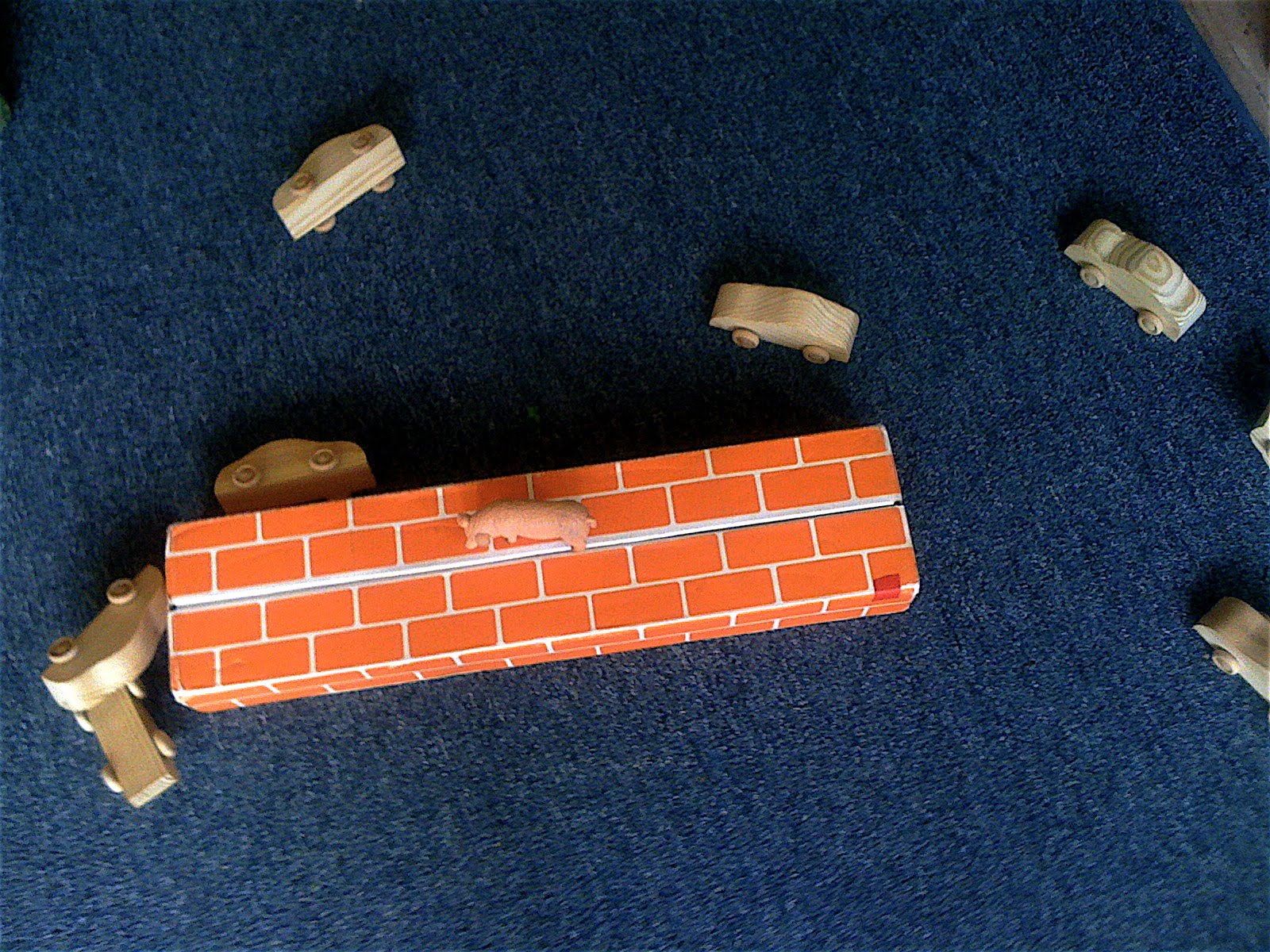
Our new basket of "every day" cars got quite a bit of action, although didn't have to serve their primary function as comfort/distraction items.


Their day will come, but not this week.

As we ended our day, the children, as they always do in the Pre-3 class, came up to hug me goodbye. Henry looked me right in the face and said, "You're silly." That kid really knows how to give a compliment.

Bookmark and Share

Tuesday, September 14, 2010

"You And Your Friends Agreed . . ."


The children in Woodland Park's 3-5's class make their own rules. Yesterday, as I was making last minute preparations for our first day of school, I removed last years list of rules from the wall. Since I've already described how we go about making our rules, I will only go into our process here to mention that the rules that make the list are the ones that are approved by a consensus of the entire community of children.

We add to this list throughout the year. The adult's role is to observe when one of these rules is being violated, point to the list and say, "You and your friends agreed that there would be no hitting (or kicking, or name calling, etc.)." I love how the children then look at the list on the wall, almost as if they are reading it.

I am not exaggerating when I say that in ninety-nine percent of the cases, this is as far as we need to go. In fact, as I sit here writing this, I cannot think of a single instance in which it was necessary for the adults in the room to go beyond pointing out, "You and your friends agreed . . ." A few years back, Henry O. used to play policeman. This entailed patrolling the room and reminding people, "You and your friends agreed . . ." It worked just as well when the reminders came from a kid.

During the summer program, with the ever-changing collection of kids, some of whom without prior experience in our school, we didn't use this rule-making method, although the list remained on the wall. One day, while eating snack, one of the "new kids" talked about breaking one of the "old rules." Charlie B. informed him it was against the rules. The child responded, "What happens when you break the rules?" Charlie paused for a moment, then answered, "We just don't break the rules."

Here are the rules under which our 2009-2010 class operated:

No punching
No real or pretend guns
No kicking
No stomping on fingers
No pinching
No cutting off fingers
No hitting
No dropping blocks on people
No pretending other people are dead
No calling people "Yuck"
No name calling
No throwing water, especially on glasses and especially on people
No ripping special boards, except Max's ("Special boards" refers to the displays of photos children bring into class in honor of their birthdays. Max was okay with having his ripped, although no one took him up on it.)
No hitting toys
No throwing grenades or dynamite
No screaming inside
No standing on sharp things
No knives
No putting knives in people's eyes
No throwing stuff at people
No standing on drums
No skateboards
No ripping birthday throne
No throwing people in water
No throwing paint or glue on people
No standing on tables
No slamming faces
No ripping down the school
No slamming people in the door
No sticking knives in people's noses
No throwing pumpkins at people
No holding ponies up high (Referring to stick ponies)
No bowling inside
Boys and girls allowed
No beating people up
No painting other people
No pushing people off the birthday throne
No grabbing other people's stuff
No yelling into the microphone (We learned about this one the hard way)
No putting nails in people's ears
No wasting food
No banging heads
No throwing things on people
No putting gravel on people's heads
No throwing knives and pens and paint and dirt
No lighting bombs
No getting in the toilet
No getting off the blue rug at circle time
No messing up bows and scarves
No throwing rocks
No throwing pumpkin juice
No putting nails in people's legs
No leaving without a grown-up
No painting people's noses
No putting knives through feet
No slamming eyes in a door
No cutting feet or hands
No cutting ears
No hitting people with bells
No stepping in sticky mud (I tried to warn them against this rule, but they all agreed. I was later told that the mud they were stepping in was "gooey," not "sticky.")
No throwing bells at people
No splashing water in people's eyes

Bookmark and Share

Monday, September 13, 2010

Planting Seeds Of Revolution

Last week on the first day of school at Shadle Park High School in Spokane, Washington, an English teacher handed out the lyrics to a song called "Commencement Day" by the Seattle hip hop duo Blue Scholars and was suspended pending an investigation. It's not clear whether the school objects to the sprinkling of swear words or the content of the lyrics themselves, but I suspect it's more the later than the former because when I walk the halls of my daughter's middle school I hear much worse language and while I'm far removed from high school, I'm confident that there was no one in my graduating class with virgin ears, just as I'm equally certain that no one has ever emerged from a US public high school whose eardrums haven't vibrated to the beat of f-bombs and s-bombs.

No, I'm pretty sure the school is concerned about the content.

I wasn't familiar with this act until last week, but Charlotte's dad Rob, a fine, respectable citizen by anyone's standards, tells me that "Commencement Day" is a song from one of his favorite albums. Having listened to the song and read through the lyrics, I have to say I find it a thoughtful critique of public education.

But peace to the people who don’t ever preach in the front of a classroom
All day long, planting seeds of revolution,
We dedicate this song.

Because isn't that what a teacher really does, after all, plant seeds of revolution? I'm certainly trying to plant those seeds, even as a preschool teacher. I want the children to think, to question, and to develop their own ideas about how the world could and should work, you know revolutionary ideas. I want them to know that they can speak up, stand their ground, and be heard even if it seems like "people ain't gonna change," because "there might be somebody out there, you never can tell."

Humanity always winds up placing its hope in the next generation, but what hope is there if we haven't planted the seeds of revolution? That is the essence of education, it seems to me, planting those seeds, and if we aren't doing that then, really, isn't it just indoctrination? If all we're doing is treating children as empty vessels to be filled with officially approved facts and formulas, then how can things ever get better? And there is always room for improvement.

Revolution in thought, in art, in science, in politics, in education, this is the way we move forward as a species. I can understand this might seem threatening to the defenders of the status quo, those who are afraid of change, who are threatened by the idea that the world isn't already a perfect place. They tend to conflate "revolution" with "rebellion," and it certainly might include that. They are worried that they might have to learn a second language, or absorb a new theory, or change how they have always done things. Revolution is hard and for the most part it must be lead by the young. We old people, when we feel the world spinning out of control tend to look backwards to supposedly better times, but there's no turning back. This thing only moves forward and it is fueled by revolutions, both large and small.

One of my proudest moments as a teacher was the day my Pre-K students revolted against me, in fact they rebelled. I've written before about our examination of Martin Luther King, one of the 20th Century's most important revolutionaries:

Traditionally, I introduce our Martin Luther King, Jr. Day material in our Pre-K class with an object lesson in fairness by taking something like these jewels (which are really just bits of plastic from our art supplies) and imbuing them with value by making them seem scarce. In a normal year, I’ll say something like, “I’m going to give each of the girls one of these jewels,” which elicits howls of protest from the boys. I then take the jewels back and instead exclude the girls to similar effect. Tears are not uncommon. I’ll then give them only to children with curly hair or stripped shirts or other arbitrary dividing points until someone suggests just giving one to everyone. After all, that’s the fair thing to do.

This year, however, something happened that has never happened before. Even before I was done distributing the jewels to the girls on the first round of the activity, Annabelle said, “That’s not fair, you should give them to everyone.” While the boys sat in silence, the girls, already clutching their prized jewels, joined Annabelle, “Give them to everyone.” I tried to continue the process of unfair distribution, but I had a mini-rebellion on my hands. Katherine said, “You should either give them to everyone or don’t give them to anyone,” and she tried to hand hers back.

I gathered all the jewels and tried to plow forward with my plan to give them only to the boys, but the protests grew louder. Instead of the usual tears, I was looking out at genuinely angry little faces. “Give them to everyone!” “That’s not fair!” “We should all get one!”

I felt like the segregationists must have felt. This is why I want the children of Woodland Park to know it’s okay to question authority. I’m here to teach children so that they can grow up to be well-educated citizens, and there is no more important responsibility of citizenship than to stand up to authority when it is being arbitrary and unfair. I didn’t just let them “win,” they compelled me to give up on my nefarious plans through a powerful, peaceful protest that relied on words and reason.


Bookmark and Share